Bee activity has slowed down in the bee hotel but there are still a few bees preparing their nest chambers. Some bees like below, have closed the chamber with a strange saliva like substance that looks like bubbly plastic!
With all these pictures, it is much better to click on them to see them much sharper and clearer, not to mention larger.
Below were the first six nests of my yellow and black bee that I mentioned in a previous post - well I have now discovered that it is a Wool Carder Bee (Anthidium species), who don’t use leaves or mud to line their nests, but plant hairs! I don't have any obvious furry leaved plants but there is furry stuff on the spent flowers/seed pods of Perovskia, so it might have come from that. If you look at the two pictures below, you'll see one chamber in preparation, lined with cotton wool like stuff. The other five chambers below have been sealed off; I'm guessing from the colours that four are with some kind of chewed up plant material and the brown one with chewed woody stuff or soil.
This bee eventually made nine nest chambers! She was one busy bee. 😀 I have also seen one again in my herb bed, displaying a rather strange behaviour of buzzing and hovering around a couple of my herbs that are in bloom, occasionally stopping on a flower for a nano second only to buzz off again and continue this strange patrolling. The males of Anthidium manicatum display territorial behaviour, patrolling around their favoured plants and chasing off other pollinators, whilst waiting for females to appear, so it's possible other Anthidium bees do the same. I have no idea how long their nesting season goes on for, so cross fingers there may be more nests in the bee hotel from this species!
There are 11 species of Anthidium in France whilst only A. manicatum in the UK, so I can't be sure which exact species is my bee, though I don't believe they all collect plant hairs. I really don't have the time right now to research this further.
Other solitary bees have chosen the cut pieces of bamboo for their nest chambers, although what has struck me since these chambers were sealed off, is that some of them have been broken into. I know there are parasitic wasps, and also other bees who lay their eggs in the nest chambers of other bees (they are known as Cuckoo Bees), but what has surprised me is that they haven't resealed the chamber. It's not just this one below (top right bamboo), but other different sized holes from other bees have also shown this breaking in....
.... like these tiny holes here - some on the bottom row have been broken into.
So you can see, so much to study and research and keep me occupied! It's all so fascinating and I look forward to seeing a whole year in the life of my bee hotel next year. And I must remember to take my camera out more often and take photos of the bees!
******
Now back to my Wasp Spiders. Below is a young one.
And this is a freshly made web (when the spider wasn't around). The zigzag stabilimentum is quite clear here with a furry mass of web where the spider tends to hang around.
Here we have a very slightly older spider with a male very close to her. Males are very small in comparison to the adult spiders, which you'll see a bit further down. I saw many males this year though I never saw them doing the actual business nor being eaten! Note also in this photo is a moult, known as an exoskeleton. Like many insects, as they grow they shed their outer shell. I tried to take one to keep when the spider wasn't there any more, but it fell apart in my fingers, it was so delicate.
A more mature spider with its wrapped up dinner.
This is part of our ditch between us and the neighbours where many of the spiders could be found, especially around the Oregano which is abundant in the ditch area. This ditch is a passageway for butterflies and other insects, so a good place for spiders to find food.
Underside view of a male spider on its own - I found that after some of the females disappeared that the males would hang around alone for a few days until they presumably went off to find another female.
Now here's a mature female from the under side, with two males. Lucky lady - she had a choice!
You can really see the difference in size now.
This is part of my Nectar Bar and in this patch there were eventually seven mature Wasp Spiders!
The most I counted at one time was 23, but sadly, one by one they disappeared, whether they have been predated or what, I don't know. I'm very disappointed as I think I had some around until September last year, and I have only found one egg sac so far, in the Valerian. Hopefully there will be more in the ditch.
I read that Wasp Spiders can be predated by birds, praying mantises, lizards and wasps, that's not all wasps but probably one of the spider hunting wasps.
We are off in the Moho next week to Provence again, but further to the north of the region in some of the regional parks in the mountains that we haven't visited before, though we'll finish off at our favourite beachside campsite for a few days as usual!
I'll then write about some of our travels during the winter like I did last year. See you in a few weeks! 😀
Blog Header
Showing posts with label Wasp spider. Show all posts
Friday, 30 August 2024
Tuesday, 10 October 2023
I found some Wasp Spider egg sacs!
Hola from Spain!
We are at the beginning of a three week trip to Extremadura and Andalusia, mixing birding with Moorish architecture and Roman ruins and anything else we find of interest. So I will probably be rather quiet where posts are concerned.
In the meantime, as I don’t have hundreds of photos to go through as we are just en route at the moment, I thought I’d do a quick post from my iPad showing you the egg sacs I found. I had been hoping to find some, but I hadn’t looked up what they look like, which helps. I was amazed - they are a real work of art. A Greek urn, is how I’ve seen them described. And they are big! I think the description of hen egg size might be a bit misleading but they are certainly a good 2cm - 2.5cms.
It took a while to find one, but after the first I found three more. They make them close to where their webs are. Not necessarily on vegetation either, as my friend Andrea in Germany also had a Wasp Spider in her garden. However when she finally found the egg sac, it was actually attached to the wall behind the shrub where the web had been. And - biggest surprise of all - there were two egg sacs! Now I hadn’t read that they can make two egg sacs, but I did then wonder about my ‘big girl’, who had disappeared for a few days earlier on, then came back with a fresh web looking a bit slimmer. And then it happened again. So after she was gone for good, I had another look through the Valerian, and sure enough, there was a second egg sac!
I will be having a good look through the ditch when we get home, as sadly all the spiders had gone by early October. I miss them!
We are at the beginning of a three week trip to Extremadura and Andalusia, mixing birding with Moorish architecture and Roman ruins and anything else we find of interest. So I will probably be rather quiet where posts are concerned.
In the meantime, as I don’t have hundreds of photos to go through as we are just en route at the moment, I thought I’d do a quick post from my iPad showing you the egg sacs I found. I had been hoping to find some, but I hadn’t looked up what they look like, which helps. I was amazed - they are a real work of art. A Greek urn, is how I’ve seen them described. And they are big! I think the description of hen egg size might be a bit misleading but they are certainly a good 2cm - 2.5cms.
It took a while to find one, but after the first I found three more. They make them close to where their webs are. Not necessarily on vegetation either, as my friend Andrea in Germany also had a Wasp Spider in her garden. However when she finally found the egg sac, it was actually attached to the wall behind the shrub where the web had been. And - biggest surprise of all - there were two egg sacs! Now I hadn’t read that they can make two egg sacs, but I did then wonder about my ‘big girl’, who had disappeared for a few days earlier on, then came back with a fresh web looking a bit slimmer. And then it happened again. So after she was gone for good, I had another look through the Valerian, and sure enough, there was a second egg sac!
I will be having a good look through the ditch when we get home, as sadly all the spiders had gone by early October. I miss them!
Wednesday, 16 August 2023
It's a good year for the Wasp Spider
If you are receiving this via email, please accept my apologies for the lack of posts in recent months. Please read the end of this blog where I explain.
Our first summer here I found three Wasp Spiders (Argiope bruennichi) in the garden, but since then, nothing. Imagine my surprise when deadheading in the Nectar Bar to realise I was disturbing a huge Wasp Spider! I then discovered one in the herb garden that same day, and in the last few days have been finding more.
In all I have counted 14 in our garden! Most are in the ditch between our property and the gardens on the hillside next to us. The ditch is for run off during heavy rainfall, but is a godsend for wildlife as it's full of wildflowers and is just a wild jungle really, so a good place for creatures to hide from predators. Unless you are a pollinating insect, and the whole ditch has become one big Wasp Spider hang out!
This spider above has a stabilimentum (the zigzag decoration) on its web, but I noticed that most of them don't. It could be that the stabilimentum has been disturbed by the amount of wind we get. The first spider that I found had its stabilimentum disturbed by me and whilst the spider eventually respun a great new web, it didn't bother with this part of it. A bit puzzling! However it's not known what purpose the stabilimentum actually serves though there are several hypotheses.
Below is the one I first found in my Valerian in the Nectar Bar. It's one of the biggest, though they really range in size even in a small area like my garden.
The following two are taken showing the underside of the spider.
This one has a juicy fly or bee wrapped up in silk, or, quite possibly, her mate! I have noticed in one photo I took of this spider, three males hanging around the outside of her web. What's wrapped up is stripy though, and the males are rather brown looking and much less decorative, not to mention a lot smaller. You can see a picture of a male and a female together here.
I'm now going to look for their egg sacs, as I have yet to see one. They are supposed to be hung in the vegetation near the web and resemble an upturned Greek urn. Fingers crossed!
Email Subscribers
I only noticed a month or so back that I wasn't receiving my own copy of my blog via Feedio. I have no idea what happened but they have disappeared off the face of the internet, so I have had to find another provider to send emails out to you. I have gone with follow.it and let's hope they stick around for longer!
You have missed quite a few posts - I don't know from when exactly but it was early on this year I think.
Here are links to the posts I've made (most recent first) that you may be interested in reading:
I think that's about it. Hope you enjoy the posts and thank you for following Chateau Moorhen!
Our first summer here I found three Wasp Spiders (Argiope bruennichi) in the garden, but since then, nothing. Imagine my surprise when deadheading in the Nectar Bar to realise I was disturbing a huge Wasp Spider! I then discovered one in the herb garden that same day, and in the last few days have been finding more.
In all I have counted 14 in our garden! Most are in the ditch between our property and the gardens on the hillside next to us. The ditch is for run off during heavy rainfall, but is a godsend for wildlife as it's full of wildflowers and is just a wild jungle really, so a good place for creatures to hide from predators. Unless you are a pollinating insect, and the whole ditch has become one big Wasp Spider hang out!
This spider above has a stabilimentum (the zigzag decoration) on its web, but I noticed that most of them don't. It could be that the stabilimentum has been disturbed by the amount of wind we get. The first spider that I found had its stabilimentum disturbed by me and whilst the spider eventually respun a great new web, it didn't bother with this part of it. A bit puzzling! However it's not known what purpose the stabilimentum actually serves though there are several hypotheses.
Below is the one I first found in my Valerian in the Nectar Bar. It's one of the biggest, though they really range in size even in a small area like my garden.
The following two are taken showing the underside of the spider.
This one has a juicy fly or bee wrapped up in silk, or, quite possibly, her mate! I have noticed in one photo I took of this spider, three males hanging around the outside of her web. What's wrapped up is stripy though, and the males are rather brown looking and much less decorative, not to mention a lot smaller. You can see a picture of a male and a female together here.
I'm now going to look for their egg sacs, as I have yet to see one. They are supposed to be hung in the vegetation near the web and resemble an upturned Greek urn. Fingers crossed!
Email Subscribers
I only noticed a month or so back that I wasn't receiving my own copy of my blog via Feedio. I have no idea what happened but they have disappeared off the face of the internet, so I have had to find another provider to send emails out to you. I have gone with follow.it and let's hope they stick around for longer!
You have missed quite a few posts - I don't know from when exactly but it was early on this year I think.
Here are links to the posts I've made (most recent first) that you may be interested in reading:
Pyrenean Escapade with Birding Languedoc Part 2
Pyrenean Escapade with Birding Languedoc - Part 1
Wildflowers and orchids on a hillside in Laurac
Black Redstart nest and new butterflies in the garden
Orchids at home and another trip with Birding Languedoc
Orchids, butterflies and more in the Upper Aude Valley - Part 2
Orchids, butterflies and more in the Upper Aude Valley - Part 1
I think I need to catch up a bit
Look what the snow brought!
I think that's about it. Hope you enjoy the posts and thank you for following Chateau Moorhen!
Monday, 20 July 2020
Some interesting spiders and insects
One of the most prolific wildflowers flowering at the moment is scabious, which is growing in all the verges and fallow spaces. Of course this is great for me as it's a flower that attracts all sorts of pollinators, and in turn, predators! On a recent walk up to the highest hill in our area, which has an amazing 360 degree view of all the hill and mountain ranges in the Aude and the Ariege, I came across this interesting crab spider. I haven't seen one this shape before (I don't think!). It's Thomisus onustus, part of the family of Thomisidae spiders. This one is similar to the one I used to find in my last garden, Misumena vatia, which changes colour to yellow or white, with some pink markings, though this one can be bright pink all over. Like all crab spiders, they don't spin webs but sit on a flower and wait for prey to land to take nectar and pollen. This link at Wikipedia shows a number of pictures of the spider in its various colour forms.
Last week we discovered another of my favourite spiders, the Wasp Spider, in our garden! Keith was pointing out a spider in a pot of geraniums, when I noticed another small spider nearby that I didn't recognise, but I certainly recognised the familiar zigzag pattern on the web, known as the stabilimentum, indicating the family of Argiope spiders. I had to take photos to see what the markings were of the spider as it was too small to tell, though within a week the spider had grown so much that it was easily ID'd with the naked eye!
Amazingly I discovered another one in a photo! I was looking at some photos I had taken of the hibiscus out the front of the house, when I spotted a web in the corner of one of the photos, which when I zoomed in, yes, it also had a stabilimentum! I dashed outdoors and it was another Wasp spider about the same size as the first one. It could even be that one as the original one has disappeared from the geraniums. Look just below the centre of the photo and there's a vertical thick white line with a spidery blob in the centre - this is a very cropped in part of the original photo. It's always amazing what one discovers in the way of wildlife in photos! I just hope that the Wasp spiders stay around the garden until they get huge in the early autumn.
Now, onto insects. Keith spotted this next critter, but on the wall of the house near the garage, and at about 5cm/2 inches long, it wasn't hard not to notice! It's an antlion, something I've never seen before. It's related to lacewings, owlflies and mantidflies (would love to see one of them!!). All of these insects are very interesting looking but I know very little about them. Antlions have very predatorial larvae, some of which dig holes to trap passing insects. This particular species doesn't do that though. According to my Med. insect book, this is one of the most commonly photographed species of antlion in the Mediterranean. Most likely that means it's one of the most commonly seen! It's Distoleon tetragrammicus, and it's habitat is oak and pine woodlands where the larvae live in the leaf litter.
Finally my favourite insect - the butterfly of course! I have been hoping to see one of these Geranium Bronzes, even though I know that technically they are a pest of geraniums/pelargoniums. They are not native, having been brought in to Europe by accident from their native South Africa; however there it has natural predators plus geraniums grow in the wild being also native to South Africa, so it's not a pest as its numbers are naturally controlled.
It's a tiny little thing and I've seen them a lot fluttering around my pots of geraniums and also feeding on nearby scabious on the grassy bank at the edge of our property. It's certainly going to be interesting seeing what happens to my geraniums. The caterpillars bore into the stems of the plants and eat them, and the stems turn black, which harms the plants. I can live with some damaged stems, but obviously don't want to lose all my geraniums. If I do find this butterfly problematic, I'll have to plant out fewer geraniums and more different bedding plants in my decorative pots around the pool/house area. I already have bedding verbena mixed in with the geraniums, but the snails seem to love eating them, whilst leaving the geraniums alone - you can't win!
I haven't taken many macros of butterflies so far this year, just because most of the species I've seen have either been too flitty or weren't close enough. This following butterfly was happy enough feeding on the oregano growing in the ditch next to our garden, but wasn't easy to get too close to. Plus it's windy here - the Aude is the windiest department in France, and we live on top of a hill. So getting a macro in focus isn't the easiest thing here at times!
It's been a while since I did a post about insects or spiders! But it was not surprising that I would find some different species now that I live in an entirely new part of France, with a different climate. Sadly I no longer have my moth trap as it went up in the 'Great Barn Fire of 2018' because I might finally have found a Death's Head Hawk Moth! I'm just hoping to find some really groovy butterfly species, like the Nettle Tree butterfly or Spanish Festoon, when we are out and about closer to the coast. Cross your fingers for me!
![]() |
| Thomisus onustus |
Last week we discovered another of my favourite spiders, the Wasp Spider, in our garden! Keith was pointing out a spider in a pot of geraniums, when I noticed another small spider nearby that I didn't recognise, but I certainly recognised the familiar zigzag pattern on the web, known as the stabilimentum, indicating the family of Argiope spiders. I had to take photos to see what the markings were of the spider as it was too small to tell, though within a week the spider had grown so much that it was easily ID'd with the naked eye!
![]() |
| Young Wasp Spider (Argiope bruennichi) living in a pot of geraniums |
![]() |
| Argiope bruennichi |
Amazingly I discovered another one in a photo! I was looking at some photos I had taken of the hibiscus out the front of the house, when I spotted a web in the corner of one of the photos, which when I zoomed in, yes, it also had a stabilimentum! I dashed outdoors and it was another Wasp spider about the same size as the first one. It could even be that one as the original one has disappeared from the geraniums. Look just below the centre of the photo and there's a vertical thick white line with a spidery blob in the centre - this is a very cropped in part of the original photo. It's always amazing what one discovers in the way of wildlife in photos! I just hope that the Wasp spiders stay around the garden until they get huge in the early autumn.
Now, onto insects. Keith spotted this next critter, but on the wall of the house near the garage, and at about 5cm/2 inches long, it wasn't hard not to notice! It's an antlion, something I've never seen before. It's related to lacewings, owlflies and mantidflies (would love to see one of them!!). All of these insects are very interesting looking but I know very little about them. Antlions have very predatorial larvae, some of which dig holes to trap passing insects. This particular species doesn't do that though. According to my Med. insect book, this is one of the most commonly photographed species of antlion in the Mediterranean. Most likely that means it's one of the most commonly seen! It's Distoleon tetragrammicus, and it's habitat is oak and pine woodlands where the larvae live in the leaf litter.
![]() |
| Antlion Distoleon tetragrammicus |
Finally my favourite insect - the butterfly of course! I have been hoping to see one of these Geranium Bronzes, even though I know that technically they are a pest of geraniums/pelargoniums. They are not native, having been brought in to Europe by accident from their native South Africa; however there it has natural predators plus geraniums grow in the wild being also native to South Africa, so it's not a pest as its numbers are naturally controlled.
It's a tiny little thing and I've seen them a lot fluttering around my pots of geraniums and also feeding on nearby scabious on the grassy bank at the edge of our property. It's certainly going to be interesting seeing what happens to my geraniums. The caterpillars bore into the stems of the plants and eat them, and the stems turn black, which harms the plants. I can live with some damaged stems, but obviously don't want to lose all my geraniums. If I do find this butterfly problematic, I'll have to plant out fewer geraniums and more different bedding plants in my decorative pots around the pool/house area. I already have bedding verbena mixed in with the geraniums, but the snails seem to love eating them, whilst leaving the geraniums alone - you can't win!
![]() |
| Geranium Bronze (Cacyreus marshalli) |
![]() |
| Geranium Bronze (Cacyreus marshalli) |
I haven't taken many macros of butterflies so far this year, just because most of the species I've seen have either been too flitty or weren't close enough. This following butterfly was happy enough feeding on the oregano growing in the ditch next to our garden, but wasn't easy to get too close to. Plus it's windy here - the Aude is the windiest department in France, and we live on top of a hill. So getting a macro in focus isn't the easiest thing here at times!
![]() |
| Grizzled Skipper (Pyrgus malvae) |
![]() |
| Grizzled Skipper (Pyrgus malvae) |
It's been a while since I did a post about insects or spiders! But it was not surprising that I would find some different species now that I live in an entirely new part of France, with a different climate. Sadly I no longer have my moth trap as it went up in the 'Great Barn Fire of 2018' because I might finally have found a Death's Head Hawk Moth! I'm just hoping to find some really groovy butterfly species, like the Nettle Tree butterfly or Spanish Festoon, when we are out and about closer to the coast. Cross your fingers for me!
Wednesday, 2 September 2015
After the rain and some interesting critters found in the local area
I'm starting off with photos from two weeks ago when I was feeling up for a walk to the local track which we call the 'Melodious Warbler Walk'. The birds are still around but not melodious any more as they have stopped singing as mating season is well over. This time it was pretty dry but there were still a fair few wildflowers, notably Knapweed, which both butterflies and bees love. But it's getting a bit overgrown with this year's bramble growth so some of the wild plants are getting swamped. It was the only place I could see in the neighbourhood where the verges have not been chopped back, but as this is a farm track leading to some fields, it's not being managed the same way as proper roads where the council often seems to chop, hack and remove all growth just as the wildflowers are starting to look lovely!
I was really chuffed to find a butterfly which I have only seen a handful of times - it's a Sooty Copper and for once, it's the female of the species which is the more colourful! The male's upper wings are a rather sooty grey with a few spots and only a vague hint of copper.
A warning as the next two photos are of a spider - BUT! This is the most amazing beautiful spider in northern Europe so go on, do have a look.....
I spotted this Wasp spider and was over the moon, as although we had one in our garden about 9 or 10 years ago, it was before I was really into spiders and whilst K took some photos, in those days digital cameras only took small pics and we didn't have macro lenses or functions on our cameras either. I've wanted to see one again ever since so I could have a better look and take my own photos. They are part of the Argiope family which are orb weavers, and the zigzag bit of the web is called a stabilimentum. Nobody really knows the reason for this but there are various theories.
We went back yesterday looking to see if we could find her again, as I'd learned that they make their egg sac nearby and it is enormous - indeed the spider itself is rather large. But although we found not just this one again, but four more, we could see no signs of egg sacs. I was really pleased to see so many spiders as it means this is pretty good habitat for them; the place is crawling (or hopping!) with grasshoppers, which make up the vast majority of their diet, but seeing what was wrapped up for dinner in various webs they are happy to eat all sorts of other insects too. No shortage of food around here!
And then the rain came just in the nick of time as the countryside was so dried out and looked so miserable. You saw the photos of my poor dried out garden and brown lawn! A week of heavy rain has done wonders and this August we have had more than double the average rainfall - many months in summer we get a lot less than the average which is why everything suffers, and our average rainfall is not very high anyway (about 50mm per month Feb to Sept for Rennes; there are no records for my local area of course apart from mine), which when you have free draining sandy soil is even worse! But now ten days later the countryside is green, the yellow leaves on the trees have blown off in the strong winds we had over a couple of days, and everything is breathing a sigh of relief. Including us, as we no longer have to spend time and money watering the garden!
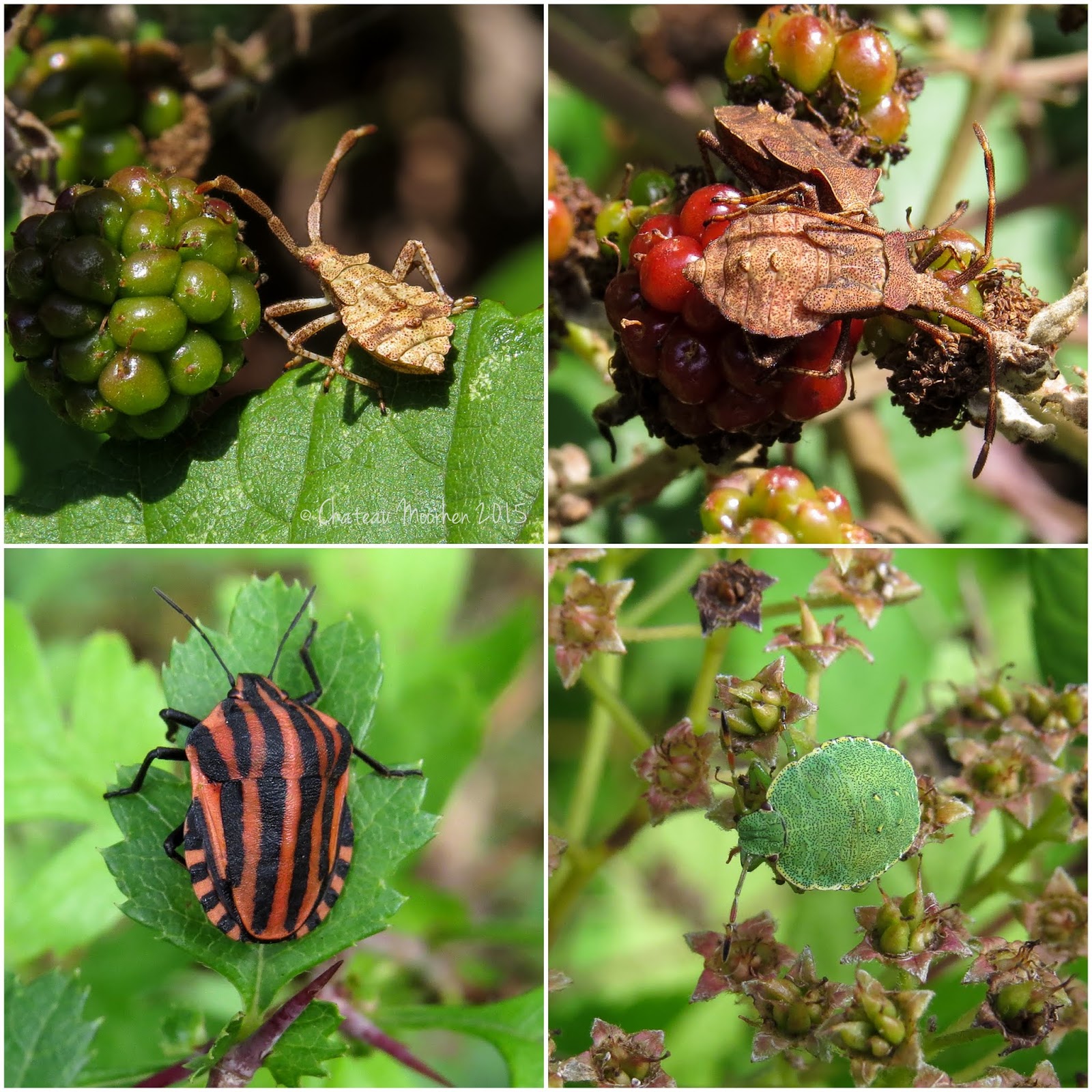
Since taking the photo below, only on 29th August, weeds had grown a lot! I hand weeded amongst the lettuce, coriander and spinach yesterday - first real gardening I've done in a while, if you don't count flicking off the eggs laid on the brassicas - not just from Small and Large White butterflies, but also those pesky Ornate Shield Bugs (Eurydema ornata) which eat my brassicas. It's so lovely to have damp soil, but even with the cooler weather my lettuce (in the first row) bolted. But that means happy chickens.
There were casualties due to the rain and wind - this very tall hollyhock is now nearly prostrate despite having been tied up to the fence! And many sunflowers are leaning at 45 degrees whilst others have been completely uprooted. But it's late in the season and by this time of year I'm usually beyond caring. Nearly all the plums split open due to the sudden rain so we managed to harvest about 20 in all from two trees. The wasps are happy. However K has picked loads of pears from one of our trees which is having its most bumper year yet - so just hoping the ones in the fridge will hang on until I'm up to cooking a pear clafouti when I come out of the final chemo slump...... one of my favourite desserts.
Strangely this year my different Sedums are starting to flower all at the same time; they are usually staggered in their flowering times. Insects love sedums!
I'll be kind and not share the photos I just took of a poor Holly Blue still struggling in a spider's web with the spider crawling all over it!
Now for some eggs - I think they may be Common Green Shieldbug eggs (edit - probably not!) but won't know for sure until they hatch and I see the bugs. I've been watching them every day and you can see the changes in egg colour over the course of time. Close up (if you click on the image) you'll see what looks to me like little fish faces with smiles inside the eggs! This morning four of the eggs are white again indicating four have eclosed and there are two which appear black with something dark coming out of them - but it's too difficult to really see what is going on. These eggs were laid on Smokebush 'Grace'.
Bah humbug! My last lot of chemo was supposed to be tomorrow and Friday, but they have called to cancel because my platelet count has dropped too low. They will call to reschedule..... hmmm I guess that means a couple of weeks, then another blood test to check..... I really have no idea. I had just received an appt for an after chemo PETscan so maybe that will have to be postponed too. So frustrating and confusing too because 4 weeks ago my platelets had gone up to the healthy zone, then two weeks ago dropped down low again! So they must be very low now, but unlike the Oncologist who gets his results faxed or emailed through, I have to wait to get mine in the post, usually arriving the following Monday. I had SO wanted this to be over!
Frustrated of Brittany. :-(
![]() |
| My OH wandering up the track. |
I was really chuffed to find a butterfly which I have only seen a handful of times - it's a Sooty Copper and for once, it's the female of the species which is the more colourful! The male's upper wings are a rather sooty grey with a few spots and only a vague hint of copper.
![]() |
| Sooty Copper (Lycaena tityrus), female. |
![]() |
| Sooty Copper (Lycaena tityrus), female. |
A warning as the next two photos are of a spider - BUT! This is the most amazing beautiful spider in northern Europe so go on, do have a look.....
I spotted this Wasp spider and was over the moon, as although we had one in our garden about 9 or 10 years ago, it was before I was really into spiders and whilst K took some photos, in those days digital cameras only took small pics and we didn't have macro lenses or functions on our cameras either. I've wanted to see one again ever since so I could have a better look and take my own photos. They are part of the Argiope family which are orb weavers, and the zigzag bit of the web is called a stabilimentum. Nobody really knows the reason for this but there are various theories.
![]() |
| Wasp Spider (Argiope bruennichi). |
![]() |
| Wasp Spider (Argiope bruennichi). |
We went back yesterday looking to see if we could find her again, as I'd learned that they make their egg sac nearby and it is enormous - indeed the spider itself is rather large. But although we found not just this one again, but four more, we could see no signs of egg sacs. I was really pleased to see so many spiders as it means this is pretty good habitat for them; the place is crawling (or hopping!) with grasshoppers, which make up the vast majority of their diet, but seeing what was wrapped up for dinner in various webs they are happy to eat all sorts of other insects too. No shortage of food around here!
![]() |
| Holly Blue (Celastrina argiolus) butterfly feeding on bramble flowers. |
And then the rain came just in the nick of time as the countryside was so dried out and looked so miserable. You saw the photos of my poor dried out garden and brown lawn! A week of heavy rain has done wonders and this August we have had more than double the average rainfall - many months in summer we get a lot less than the average which is why everything suffers, and our average rainfall is not very high anyway (about 50mm per month Feb to Sept for Rennes; there are no records for my local area of course apart from mine), which when you have free draining sandy soil is even worse! But now ten days later the countryside is green, the yellow leaves on the trees have blown off in the strong winds we had over a couple of days, and everything is breathing a sigh of relief. Including us, as we no longer have to spend time and money watering the garden!
![]() |
| In the woodland tiny thin blades of grass are emerging amongst the fallen leaves. |
Since taking the photo below, only on 29th August, weeds had grown a lot! I hand weeded amongst the lettuce, coriander and spinach yesterday - first real gardening I've done in a while, if you don't count flicking off the eggs laid on the brassicas - not just from Small and Large White butterflies, but also those pesky Ornate Shield Bugs (Eurydema ornata) which eat my brassicas. It's so lovely to have damp soil, but even with the cooler weather my lettuce (in the first row) bolted. But that means happy chickens.
There were casualties due to the rain and wind - this very tall hollyhock is now nearly prostrate despite having been tied up to the fence! And many sunflowers are leaning at 45 degrees whilst others have been completely uprooted. But it's late in the season and by this time of year I'm usually beyond caring. Nearly all the plums split open due to the sudden rain so we managed to harvest about 20 in all from two trees. The wasps are happy. However K has picked loads of pears from one of our trees which is having its most bumper year yet - so just hoping the ones in the fridge will hang on until I'm up to cooking a pear clafouti when I come out of the final chemo slump...... one of my favourite desserts.
![]() |
| Blocked gate! |
![]() |
| Yellow and pink Mirabilis in the Pollinator Meadow. |
Strangely this year my different Sedums are starting to flower all at the same time; they are usually staggered in their flowering times. Insects love sedums!
![]() |
| Just caught one quick snap of this Robber Fly as it landed - I hadn't noticed it had a yummy fly lunch until I saw the photo! |
![]() |
| First time this year I've managed to get some close up photos of a Holly Blue (Celastrina argiolus), as this one was busy feeding on Sedum matrona. |
![]() |
| Holly Blue (Celastrina argiolus). |
I'll be kind and not share the photos I just took of a poor Holly Blue still struggling in a spider's web with the spider crawling all over it!
![]() |
| This tiny bumble bee was enjoying the Sedums too. |
![]() |
| 22 Spot Ladybird (Psyllobora vigintiduopunctata) and larva. There were lots of both on some oak leaves. |
![]() |
| A very cool looking Harvestman (Dicranopalpus ramosus). ID thanks to JJ. |
![]() |
| I found this Blood-vein (Timandra comae) moth just sitting on the lawn during the day! |
Now for some eggs - I think they may be Common Green Shieldbug eggs (edit - probably not!) but won't know for sure until they hatch and I see the bugs. I've been watching them every day and you can see the changes in egg colour over the course of time. Close up (if you click on the image) you'll see what looks to me like little fish faces with smiles inside the eggs! This morning four of the eggs are white again indicating four have eclosed and there are two which appear black with something dark coming out of them - but it's too difficult to really see what is going on. These eggs were laid on Smokebush 'Grace'.
![]() |
| Photos taken on 18th and 28th August. |
![]() |
| And to finish, a pristine looking Peacock butterfly. Although it appears its name has changed from Inachis io to Aglais io. That's annoying as I have them labelled as Inachis in my database. |
Bah humbug! My last lot of chemo was supposed to be tomorrow and Friday, but they have called to cancel because my platelet count has dropped too low. They will call to reschedule..... hmmm I guess that means a couple of weeks, then another blood test to check..... I really have no idea. I had just received an appt for an after chemo PETscan so maybe that will have to be postponed too. So frustrating and confusing too because 4 weeks ago my platelets had gone up to the healthy zone, then two weeks ago dropped down low again! So they must be very low now, but unlike the Oncologist who gets his results faxed or emailed through, I have to wait to get mine in the post, usually arriving the following Monday. I had SO wanted this to be over!
Frustrated of Brittany. :-(
Subscribe to:
Posts (Atom)