Blog Header

Blog Header
Showing posts with label trees. Show all posts

Wednesday, 5 January 2022

Le Grand Castelou Reserve near Narbonne

Last week we had a brief warm spell with no wind either, what bliss! So we took advantage one afternoon to go to the coast for a walk.

We had wanted to visit the marshy reserve of Le Grand Castelou for ages. It's situated just south of Narbonne in the Reserve Naturel Régional de la Narbonnaise en Méditerranée on the site of an old wine domaine, with a very handsome old farmhouse and attached barns at the centre. The domaine was also used for other agriculture in the dryer fields over the decades and even rice growing at one point. Nowadays Camargue horses and bulls graze as they are naturally used to wet environments. There are areas which are wilder with expanses of reeds, low growing salt loving plants like samphire, as well as small lagoons. Needless to say this encourages all sorts of wildlife and birds to the different habitats. 

When we arrived there was a light sea breeze but warm enough to not need a jacket, not bad for the end of December! There are two walks here, a smaller 2km walk which goes past the only hide, and a longer 4km walk. Of course, if you are going to the hide as well (and why wouldn't you!) it will be a bit longer as you have to detour. According to the app K uses, we walked 5.6kms. Given I have barely walked much in months I was amazed at myself, though it's all flat, which is perfect!


It's not the easiest place to navigate so I strongly suggest you take a photo of this map opposite the buildings at the start of the walks! We soon realised this so K went back to get this pic. There are paths going off in all directions and many waterways, used to bring fresh water to the agricultural areas, which would otherwise become salt marshes over time if left to nature. 

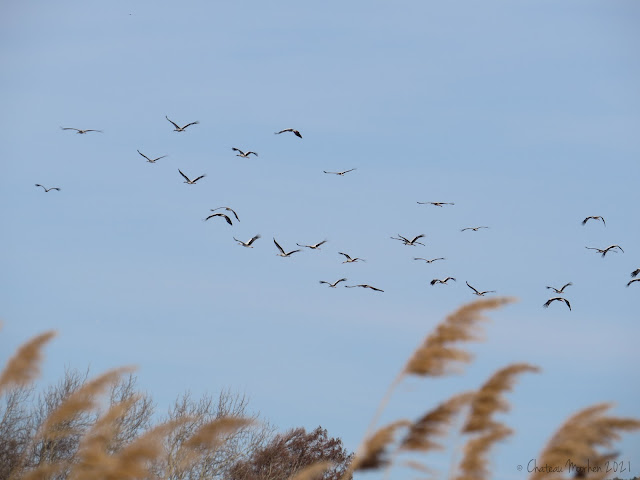
The first thing we noticed were loads of White Storks flying overhead. They are obviously happy overwintering here rather than flying south to Africa. It seems like more and more birds are staying put these days. We even saw a White Stork in Brittany on a cold Feb or March day about 10 years ago! 


A line of Plane trees. These trees are really common in the Languedoc and there are avenues of Planes between villages as well as growing in the villages and towns. I just love them because they are very majestic and have the most glorious bark. They are often pollarded and provide good shade.


We could see the White Storks in the fields as well, but it wasn't easy trying to take photographs through the reeds. With my SX50 and autofocus, I got lucky, as the camera wants to focus on the reeds in the foreground most of the time.


I was astonished to see this tree with buds and blossoms all over it - in December? I wasn't sure what it was at first, but checked when home and I should have known really. Can you tell what it is?


It's an Ash. I should have known from the 'keys' (seed pods) but the flowers threw me, as well as being in a marshy area. Being beside the Etang de Bages, close to the ocean, this area would be very mild and almost frost free in winter, but it's still ridiculously early to be flowering!

The hide had a good view over this small lagoon, and the hills we see in the distance are the other side of the main lagoon, the Etang de Bages-Sigean.


Nearly all the ducks we could see were Mallards, Pochards and Teal. There's a Pochard on the left in the middle, behind the reeds. In the foreground are mostly Teals.


Sleepy Teals, three handsome males and two females.


We didn't see too many other birds as we walked around, although we were accompanied by the sound of many Cetti's Warblers! We also saw a female Reed Bunting, a Stonechat and some Marsh Harriers. 

Some of the longer walk is along the road, but it's a very quiet road and we didn't see a single car, and only a very few people. We had a lovely view of Mt Canigou from most of the reserve. 


The village of Bages over the other side of the main lagoon.


Looking towards La Nautique, a watersports base and little port, close to Narbonne town. We were happy to see what were in the foreground, Flamingos!


Above on the right and below, a juvenile Flamingo without any pink colouring. Above there's a Grey Heron in the background.


Photo credit: Keith Allen

The next day I got my spring and summer bulbs planted in the new Pollinator Bed - yes I know I am very late doing so but the weather has been so horrible this autumn, and I'm a real fair weather gardener these days. K lent me a hand which helped me to get motivated, and so, obviously, did the mild sunny weather.

I will end by wishing everyone a Happy New Year!

Friday, 27 January 2017

Middle Spotted Woodpecker and December's tree surgery

Brrrr! We are having a cold snap with real winter weather, something we haven't had for more than a few days here and there for quite a few years. The lake has been frozen over for about a week now and every morning I have to go out and take fresh water to the hens whose water bowls have frozen solid. I'm doing the same for the wild birds' water too as they can't drink from the lake edge. It's still not been as cold as in the early years here when we reguarly had -8C, but it was down to -5C/6C a few times. I'd also forgotten about freezing pipes so we've nearly lost our kitchen cold water feed a couple of times but I've got to the tap to run it just in time, however because it's been so long since we had such a cold period I'd forgotten about the 2nd floor shower room, so the cold feed is frozen solid there! It's the first time I've worn my thermals for quite a few years too. Aaarrgh, roll on spring, I can do without all this! (However, the sun is shining all day long..... it is so much lovelier than the milder gloom and drizzle which is due to come back soon.... you just can't win!) (That blurb was written two days ago and the end of the freeze has just started with cloud and some drizzle!)

We have a new(ish) visitor to the peanut feeder. It's a Middle Spotted Woodpecker which is a fair bit smaller and a lot prettier than the Great Spotted Woodpecker. We've seen it here before many years ago (and a Lesser Spotted too) but this time it has become a regular visitor. I haven't got any very good photos so far because the only times I've had my camera to hand have been when it's been either early in the day with low light, or just plain gloomy with low light!

Having seen the state of the peanut feeder in K's photo it was time for a new one, and thankfully he found a spare feeder in the barn, ditto a seed dispenser too which is hanging on our other feeding station. I've now found a good use for the last of the rubbery windfall apples as the blackbirds are enjoying munching on them. This is the kind of weather when it's really important to feed the wild birds and especially to provide them with fresh water to drink and bathe in. (But you knew all that, didn't you?)


This is Keith's photo.


The ducks have managed to keep a small pool of water unfrozen; unfortunately for all concerned this is not close to the bank where we can put food. At first K managed to break the ice but the next day it was already too thick! Dirk is hopeless on the ice and skids everywhere and looks like he's about to break his legs, and although Rachel is managing to get up onto the ice more easily than him, she doesn't seem to want to walk over to the bank where the food is. Luckily K had a brainwave and the pole he was using to break the ice with was put to good use again - this time with the apple picking basket holding duck food! He can just reach to put the food on the ice and the ducks are happily eating it from the water. Honestly, these creatures don't want much, do they?!!


Going back to December, our 'tree man' came and felled a load of trees again, just like he did three years ago. This time some largish trees had to go, mostly due to crowding out with other trees. I had to decide which ones were most important to keep - for example, although I hate to see a beautiful lime tree being cut down, I have five of them, yet only one cedar, as we already felled one of them which had obliterated the path down to the beach. So out of three specimen trees growing into each other, the lime had to go. In the photo below it's a sycamore which has had the chop as it was shading out my liquidambar. We have loads of sycamores so that wasn't a difficult decision. All this wood will be good firewood in two years time.


The monster shredding machine. This was parked right outside the chicken run and the poor hens cowered indoors for about three days, terrified in case the scary monster started making loud noises again. Sorry hens! We have kept a lot of the shredded wood and put it down on the veg patch paths again, and also on the path leading down to the lake.


The lime tree getting the chop but one of these three trees had to go.


Originally the tree man was going to have a bash at removing the fallen stand of alders in the lake, but as the water level had risen by a couple of feet since he first viewed it this was deemed impossible and he will return next year when the water level is at its lowest. He had a mate in to help as there was a fair bit of work involved here - anyway I had a brainwave and suggested that as they couldn't do the tree in the lake, could they prune my apple trees and reduce the height considerably. We had already asked him to clear the stream banks of brambles which were taller than my head - this is a job that's bad enough doing every year but when you haven't done it for three years it gets out of control. I can tell you we both breathed a HUGE sigh of relief at not having to prune the apples and pears this year!

Taken from my living room window - man up an apple tree.


I'm surprised they managed to climb up these relatively thin branches - and so overcrowed inside the trees too.


Afterwards, one of the trees with lopped off branches. All these fallen apples have been feeding Redwings and Fieldfares this winter.


The stream is visible! The other side has now been cleared by the owners of that land - it will grow back but K is going to try to strim it and keep the brambles and nettles down. In the past I've wanted to keep the nettles for the wildlife, but there are times when nature just has to be controlled. There are tons of nettles out in the ditches for the butterflies and moths to lay their eggs on.


At this time (December) there were still some leaves clinging to the Liquidambar tree and glowing in the sunshine.


Even on the ground they retained their colour for a long time. This way you get to enjoy the colourful leaves for much longer!


I'm jumping backwards and forwards in time but I have already uploaded the photos and can't be bothered to delete and rearrange the order here! In this cold sunny snap it seemed a good time to burn all the crap we've been piling up in the veg patch waiting for there to be enough to have a good bonfire. We are not supposed to have bonfires anymore for environmental reasons and because of the nuisance to neighbours. Well we didn't really know that but we do now, although having googled to try to find the law on this one for our department, all I can find is a lot of conflicting information on government sites. What else is new?!

You can see how much stuff there was - a mix of brambles, whippy elm growth, sycamore saplings, ivy and a fair bit of dead thuya hedge, plus a lot of veg patch weeds. The official advice is to compost or shred your garden waste (we do, but you can't do this kind of thing!) or take it to the tip. This would be quite a few trailer loads plus a lot of the twigs and stems would need to be cut to fit into our small trailer, all of which takes a lot of time. I've been cracking on with clearing the jungle much faster by not having to snip up bramble stems along the way.


It did produce a lot of smelly smoke but it's not like we're doing this every week - in fact it is only our fourth bonfire here in 12 years! We won't have one again though now we know it's not permitted. Since I wrote this one of our neighbours has had a smelly bonfire..... :-)


To finish off, whilst I was clearing up our overgrown pathways I found this twig with some interesting fungi on it. It's dead wood and the twig is thinner than my finger so the fungi is really small. I wasn't entirely sure if that is what it was but the underside of the fungi looks a bit like Turkey Tails. The small bits look like scale insect though!


Honestly, the less frequently I blog, the longer my posts get. If you made it this far, well done! It's been quite a marathon for me writing it..... :-)

Sunday, 3 July 2016

Where did June go?!!

We are just back from a MoHo trip and about to go off on another one, so really making the most of this wonderfully dismal weather! This June was certainly not flaming, more like a damp squib. On the plus side, no watering of the garden and the grass is still nice and green.

Summing up June when we were at home - newly fledged birds figured high this month. Something I noticed in May, which was confirmed by a snippet I heard on Springwatch on the TV about the failure of caterpillars this year, something that happens about once every 12 years. I'd thought that there must have been a lack of the usual little green caterpillars that the Tits (particularly Blue Tits) feed to their young. Now, normally there is a period where the Tits seem to disappear, and hardly any birds visit the feeders. One fatball can last a week or more. This is during the period of the caterpillar and the raising of the young. But this year that quiet period never happened and we have been feeding the birds left right and centre these last two months. During June all the parents showed their newly fledged kids where the free meals were, and we have been going through fatballs and peanuts ever since at a rate of knots. This too is unusual as usually the newly fledged birds leave the feeders after a few days of getting acquainted with the free meals, presumably preferring to eat more natural food elsewhere. So all the more reason to feed our garden birds all year round.

A young Blue Tit, just fledged, sits on the windowsill wondering where to go next.  


"It looks nice in there".


I saved this just fledged wren from Hallie - it was an amazing sight as suddenly two little birds flew low over the veg patch and Hallie leapt into the air and caught this bird! Thank god I was there and was able to get it from her unharmed. I put the little bird in the hedge at the bottom of the garden (there were cats everywhere and no good vegetation around where I found it). I then felt guilty as Mama Wren was calling for her babies and I'd put it in a different place. Well, what can you do?!


Mama Wren calling (damn that fence wire!).


The home made feeder is looking a bit the worse for wear now - sometimes it has about 10 juvenile Tits on it, not to mention baby Great Spotted Woodpecker who visits often, plus other adult birds.


Another young Blue Tit.


And in other news - what's this hideous photo for? Well I had a tooth out. I really didn't think I'd be posting this in public but I am!! And why am I wearing a fur stole? Well it's Bertie and me trying to take selfies together. :-) OK forget the smiley face, I am in the early stages of having a bridge done involving four teeth (one now out) and two root canals..... ugh. :-( It really doesn't help that I can only understand about 30% of what my dentist says, so I have no idea why I need root canals. She's the only French person who I've ever come across who doesn't understand anything I say either!! I just have to hope for the best here.


I found a Bee Beetle (Trichius fasciatus)! I don't see these guys very often and they are so funky.


This Cinnabar moth (Tyria jacobaeae) was in the chicken shed - I thought it was dead as it was lying on the ground unmoving and then did a good impression of being dead on my hand too. Luckily for it, it started to move so I put it on this Clematis, 'The President", and it came back to life.


June marked the return of the blue damselflies, several species being spotted, though I've only seen one dragonfly here flying around the pond, and only on a few sunny warm days. 

Blue-tailed Damselfly (Ischnura elegans)


Butterflies have been very thin on the ground, with a few brave Painted Ladies and the return of our stalwarts, the Meadow Brown, usually flying low over the lawn. 


Plants are loving the damper conditions and the veg patch continues to look stunning (so long as you don't look closer at the more weedy wildflowers!). This is mid month when the Opium poppies were in full bloom and the foxgloves too. Now it's more great spires of Verbascum and Verbena bonariensis giving height. This photo is probably best clicked on to view full screen.


I left a couple of parsnips in to flower as I hadn't ever seen their blooms - I remembered that they were yellow as some years back Cleve West used them in a Chelsea design. Actually they are more stunning than I thought - quite similar to dill but a lot more chunky. Insects like them too.


Phone photo of some bugs on the parsnip flowers: Crab Spider, Red Soldier Beetle and Thick Thighed Flower Beetle.


I also left some carrots in the ground and they are flowering too - really I shouldn't be surprised that cultivated carrots look very much like..... wild carrot flowers! I found a crab spider on one of them too.


Over the garden gate - Opium poppies and our native red poppy. A lot of the white flowers here are coriander gone to seed.


Opium poppies up close - they are very photogenic.


New Heuchera bed after a weed. The little fence is working for keeping the chickens off!


Sheltering from the rain in the potting shed.


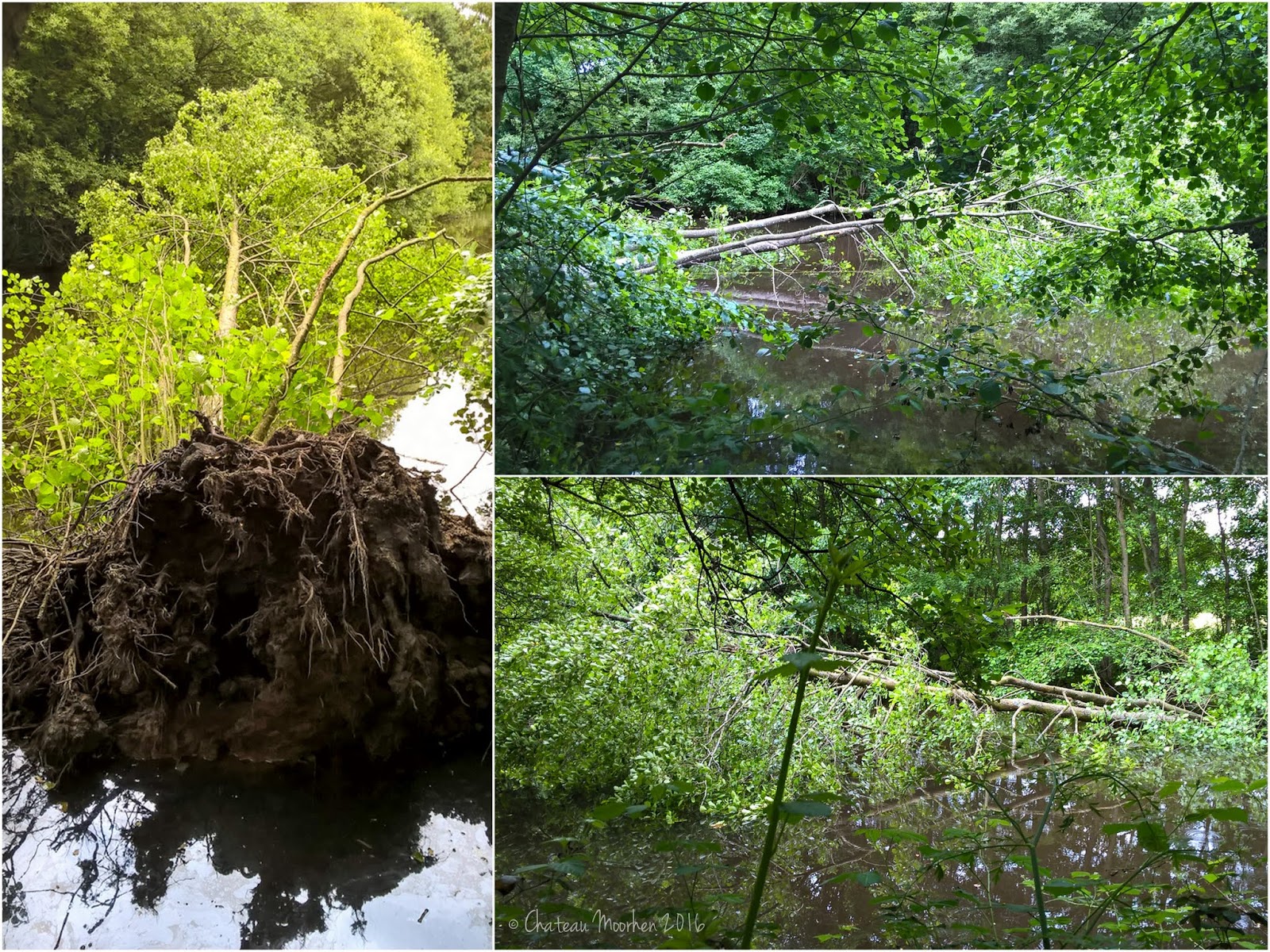
Towards the end of the month we discovered this Alder tree fallen in the lake. There is a stand of them two-thirds of the way up the pond and one of them's roots interspersed with soil stuck out into the pond a little way, like a little island. Over the years though when the water level has gone down, the tree's rootball has been tunnelled under by muskrats and probably coypu, leaving it weakened, and we have been waiting for this to happen. One smaller tree fell a few years ago, but this one has taken the rootball with it and none of it is exactly accessible. I'm not sure what will happen with this tree, but for now there's a nice Kingfisher perch which I hope will be used.


One last picture - I've had the moth trap out a few times and whilst I haven't had as much variety as I had expected for this time of year, I did bag a beautiful Elephant Hawkmoth one night.


Let's hope for some warmer weather in July, and a few more butterflies!