Blog Header

Blog Header
Showing posts with label top garden plants. Show all posts

Thursday, 21 March 2013

My top garden plants - Hydrangeas

In the early days of this blog I wrote a series about my Top Garden Plants - my favourite plants that have both visual interest, plus at least one other use, whether culinary i.e. herbs, or are of benefit to wildlife in some way (which also is the case of the herbs I featured). Most of these plants are really easy care plants too.

So I have ummed and ahhed as to whether Hydrangeas fit the bill, as they are neither really easy plants nor edible! However, having looked back through all my photos, I feel that the incredibly long season of interest - up to nine months - plus the fact that I found quite a few interesting bugs on them, and spiders especially seemed to like spinning webs on them, that they could join this series. 

When we first moved to Brittany I saw Hydrangeas everywhere in all shades of blue, purple and pink so went straight out and bought a blue one, only to find that it bloomed purple on my neutral soil. I had originally though the soil here would be acid so was surprised after doing a test to find it pH7. I was also given a pink Hydrangea, but pink ones stay pink no matter what soil type you have, whereas the blue ones need acid soil to bloom blue, unless you amend the soil with something like sequestered iron. In alkaline soil a blue Hydrangea will have pink blooms.

I also originally mistakenly planted them in the coldest part of the garden so they never grew very well and didn't have many flowers, so some years back we dug them up and replanted them up against the house wall in a north west facing position, which is quite shady until mid afternoon in high summer. Even so,  some years they have suffered from late frost and my pink Hydrangea didn't have a single flower in 2011!

Last year however, they both grew enormously and had more flowers than I've ever seen on them. The blue one, after a couple of initial purple flowers, turned a beautiful blue colour which I can only put down to the Hydrangea fertiliser that I had bought, which must have had extra minerals or some kind of colouring agent in it.

Some of these photos I have already shared here and there on this blog, but am posting them again as some are my favourite photos and I'd like to put them all together. 

The pink one is a Mophead variety (Hydrangea macrophylla), and the blue one is a Lacecap variety (Hydrangea macrophylla normalis).

The very first flowers on the pink Hydrangea in June,
with blue Campanula poscharskyana in the background

A little hoverfly flies over an unopened flower head

Late June. The blue one is on the left and has grown to a reasonable size;
the pink one far right is smaller as it is in a slightly less sheltered position.
I forgot to prune that rose last year which explains all the flowers so high up!

July and the first flowers opened up looking quite purply, although
the buds were blue. This is a little Froghopper sitting on the petal.

The fresh blooms on the pink variety open with an attractive white colour
at the heart of the flower, then gradually become darker pink

Early August and the blue variety suddenly turned a beautiful blue!

I captured a spiderling on the edge of a petal doing an octopus impersonation!

And here it had obviously watched Monty Python's 'Ministry of Silly Walks'

At the same time the pink variety was looking glorious,
and still had flowers yet to open, extending the season even more

By late September the blue variety's flowers were fading to
a pretty pinky/blue/grey colour.
I have actually captured many spiders and webs on the Hydrangeas.

Mid October and the pink variety was fading but still beautiful.
This Cricket seemed to take on the exact same pinky beige hues.... or was it a reflection?

My favourite photo.
Here are dewdrops caught in a spider's web reflecting the fading pink petals all around

Early November and the pink Hydrangea had a mix of skeletonised
petals yet some still looking quite fresh and pink.
Here's a raindrop reflecting some blue sky and sunshine.

Throughout the winter the skeletonised petals of the flowers have looked sad and soggy, but as soon as we had some dry weather, they perked up and still look very attractive. I leave them on the plants as long as possible as they help to protect the emerging fresh leaves from late frost.

Early March - how much more pretty can you get?
Yes, I really love my Hydrangeas.

P.S. I've noticed in the last 8 or so postings an enormous amount of Google +1s on my posts (as many as 20 or 30 on some posts) which previously I hadn't had more than a sprinkling of in over a year of posting on this blog. I have no idea why or how this is suddenly happening, but I'd like to thank you all very much, even though I have no idea who 99% of you are. :-)

Friday, 22 June 2012

My top garden plants - Cranesbill Geraniums

I'm resurrecting this series that I started writing during the winter showing last year's photos. These are my must have flowering garden plants which have more than one use - all must be attractive in their own right but also be of benefit to the wildlife in my garden. In the case of certain herbs already mentioned, some have other uses too such as culinary. The six previous postings from back in the mists of time are here.

So evocative of cottage gardens, cranesbills are one of my favourite flowers but I used to have such problems growing them! I'd be in awe at their magnificence in my mother's garden yet I had only pathetic straggly specimens which never reflowered. Well that was in my last garden on the other side of France where the climate is much warmer in summer than Brittany. Here, however, because of my free draining soil I have planted them in semi shady conditions and for the most part they are doing well, with only a few stragglers! There's still only one that self seeds for me, Geranium phaeum, but the way that one spreads itself around it's probably actually a good thing!

I've noticed certain cranesbills seem more attractive to pollinating insects than others. Geranium phaeum is the favourite of bumble bees, whilst 'Sirak' and x oxonianum are also visited by other kinds of bees and hoverflies. The plant in the following photo was given to me by a friend so I had no name for it, but have identified it very likely as Geranium x oxonianum (actually with thanks to the Botanical section in the Parc du Thabor in Rennes - told you it came in handy for identifying plants!).

Heineken Hoverfly (Rhingia campestris) on Geranium x oxonianum

This is quite a big bushy geranium with large leaves. I've found it grows better being given some support and many of them I've put wire cages around so they grow up and through these cages which helps to prevent them flopping when they get too tall. Here it is again with 'Jolly Bee' growing through it. Jolly Bee is more of a spreading, low growing variety and the two work well together. Don't ask me which leaf is which as I don't quite know! Jolly Bee is only just coming into flower now so is one of the later varieties and I've yet to see which insects are attracted to its flowers, if at all.

'Jolly Bee' with x oxonianum

'Jolly Bee' growing alongside pinks with blue campanula becoming rather hidden under the foliage

Next is Geranium cantabrigiense, most likely 'Biokovo' but I'm not sure if it was labelled as such. The label may well still be there under the foliage! This is a very small low growing non floppy variety which doesn't seem to diminish or spread too much over the course of the years. I haven't noticed it so attractive to insects as some of the others, but it's still worthy of a place in my garden!

Geranium cantabrigiense, with Edelweiss in bud in the centre foreground.

Cantabrigiense

A close up of Cantabrigiense

This geranium is one of my most popular with all sorts of bees and hoverflies. It's called 'Sirak'. I have it propped up with link stakes which seem to do the trick. It seems to love where I've put it, which is fairly shady apart from mid summer when it gets about 4 hours of sun a day.

Geranium 'Sirak'

In reality 'Sirak' is quite a different pink to my x oxonianum, more of a lilac pink. I see though on Google images that most that are shown look more like the pink in my photos, so it's not just me!

Geranium 'Sirak' with what I think is a Leafcutter Bee

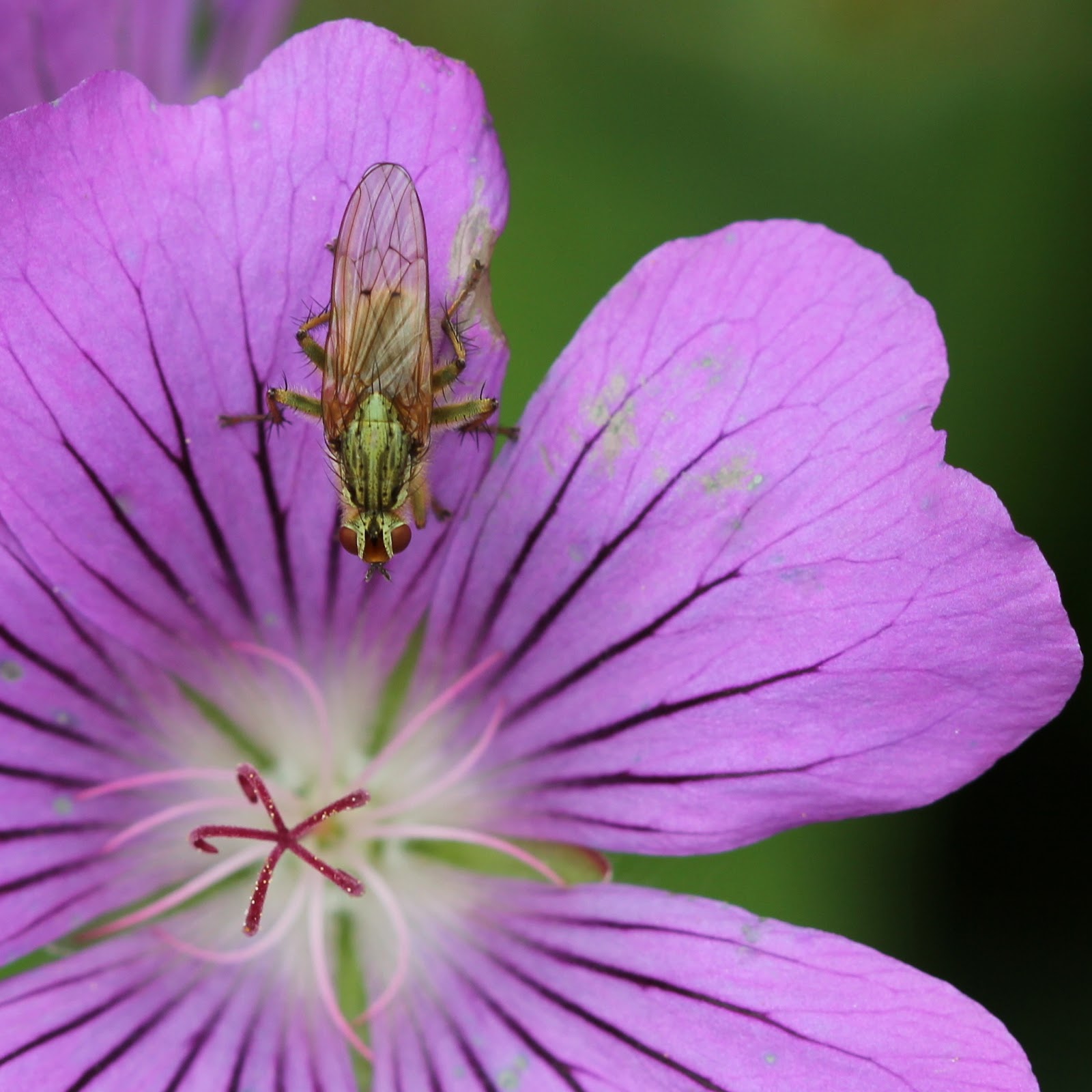
After photographing this fly around the garden for weeks now, finally I know what it is.
I'm pretty sure it's a Common Yellow Dung Fly!

Now this one is a straggler! It doesn't help that the poor plant has been rather swamped by bluebell leaves so it has struggled to get out from under them. That will be rectified later on! Even so, it has very finely cut leaves and tends to be tall and floppy, so grows better if it can interweave itself with other plants. It's one of my favourite flowers.

Geranium 'Orion'

'Orion' and foxgloves

'Orion'

Not everything is growing well. This sanguineum was big and healthy for several years but last year seemed to dwindle in size and I thought I'd lost it. It did come back this spring but is only a very small plant, hence I only took one photo of it and it's not a very good one. It's a more vivid pink than this in real life.

Geranium sanguineum

Last, but certainly not least, is Geranium phaeum. I've already sung its praises on this blog and if I was only allowed to choose one cranesbill, it would be this one. It starts flowering very early and has been going strong for about two months now, and is never without bumble bees buzzing around it. It grows in total shade as well as partial and self seeds with gay abandon. It also has very attractive leaves and is one that will come back into flower for me after a good chopping back in summer.

Geranium phaeum

Tuesday, 14 February 2012

My top garden plants - Sedums, Nasturtiums and Borage

I have many kinds of these sedums in my garden - I particularly love the ones with purple foliage as they look great even when not in flower, although their flowers are less showy than the kind in the photos below. It doesn't matter what colour their flowers or foliage are though, they are always crawling with honey bees when in flower!


They are fabulous for my very dry free draining soil and I'm trying to get more and more plants like this to save me continually watering. My purple varieties self seed all over the place but as yet the others haven't; only time will tell.


This peacock butterfly likes it too!

Nasturtiums. What a fabulous and easy plant this is to grow! I've only ever sown seed once and ever since I have a bright display growing up and through the fence of my veg patch; indeed towards the end of the growing season they've spread all through my currant bushes and gone a bit wild, so sometimes I do have to trim them back a bit. Even if their only use was the colourful flowers I'd be content. However they have many other uses!


The flowers, seeds pods and leaves are all edible and the leaves are quite hot and peppery so can be added to salads, although I wouldn't want to eat a plateful of just their leaves as I think that could be a bit OTT. Do take care not to pick any leaves covered in blackfly or caterpillars though! The flowers look brilliant decorating plates of food for your fancy summer buffet meals. The seed pods can be used to make poor man's capers although I've not tried that myself.

They are probably best known as a companion plant in the veg patch as, as well as attracting black fly they are often planted amongst brassicas as our 'friends' the cabbage white butterflies are attracted to their leaves for laying their eggs on. The idea is that they will do this on your nasturtiums rather than your brassicas - however although this may work for some I find I end up with perfect looking nasturtiums with not a hole in the leaves whilst the caterpillars happily prefer chomping on my PSB and curly kale! Oh well, good thing the nasturtiums are pretty then. They can take a bit of frost too and were still flowering here until December.

They just self seeded in amongst my brassicas last year

Borage. I've already posted several photos of this absolutely beautiful flower. The plants take up a fair bit of space and can be quite floppy but even if you only have a little bit of room in a corner of your veg patch, or a flower bed where you sow annuals, do try to have a few. Be warned though, once you've got them you've always got them and you have to be quite brutal with hoeing them off or pulling out as they will get everywhere! But I'm quite used to my plants self seeding so don't have any problems with this.


Just like nasturtium flowers, borage flowers are edible and the bright blue is just so, well, blue that again they look amazing decorating a plate of food or a salad or floating in a summery drink. The leaves are supposed to taste of cucumber but I can't bring myself to try, as they are very spiky/hairy and give me a bit of a rash if I touch them without gloves so I give this a miss.

One of the main reasons for growing them though, is that bumble bees just adore them, and they carry on flowering quite late through lightish frosts until the temps hit really below zero.


There are other plants which are attractive to bees and butterflies in my garden, but I'll wait until they are all flowering again and add them in at the appropriate time. 

Saturday, 11 February 2012

My top garden plants - Alliums

My garlic is coming along nicely, my leeks are frozen in the ground and I will be growing onions after all, thanks to a kind friend who spotted those elusive pink Roscoff onion sets and sent them to me (hugs to Mrs M xx), but, as I've never let them flower because I grow them to eat their bulbs, it's not those alliums to which I'm referring.

There's a whole host of ornamental flowering alliums too, not to mention the chive family. What can be prettier than a bunch of chives in flower in the early spring? The flowers taste good too and look lovely sprinkled over a potato salad.


I also love garlic or chinese chives which I grow mostly for the flowers, although the flat leaves which have a hint of garlic are great added to all sorts of things. They flower later in the season, usually around July to September, and are much loved by bees and some butterflies and daytime moths. Neither of these kinds of chive are too happy when my sandy soil is really dry, except of course for the ones which have happily self seeded in my really dry, compacted soil under the gravel!

Jersey Tiger Moth on garlic chives

Gatekeeper butterfly

Of the ornamental varieties the only kind I have here at the moment is Allium sphaerocephalon which is my favourite. They grow very tall but take up little room at ground level, unlike some of the larger leaved and flowered varieties. They look brilliant in mid summer poking up above or in amongst other lower growing flowers. Bees just crawl all over them too!

Just looking stunning in amongst the Rudbeckia


I saw this wonderful creature last year - after a bit of research I discovered it is a Spotted Longhorn Beetle (Rutpela maculata) - I'm assuming all that dust all over him/her is pollen! The larvae feed on decaying wood (all the more reason to leave some rotting log piles around) and the adult beetles are often found around woodland edges and clearings feeding on pollen and nectar of various flowers. I love interesting looking and coloured insects, and all the better when I do manage to ID them!

Thursday, 9 February 2012

My top garden plants - Thyme and Oregano

There was a programme on the telly last night about flowers, bees and butterflies by Sarah Raven which I recorded and will watch tonight. I thought it rather apt given I've been writing about these things, and glad I am not the only person who is discussing them in the depths of winter, which might seem a bit mad. But not only do I have the time to do so right now, if it is at all helpful to anyone reading this who may wish to do more to encourage our nectar loving and pollinating insects into their gardens then all the better to do so now at the planning stage so there is time to get that herb bed organised or flower seeds ordered!

Thyme

When we first moved here I had a very dry sloping bank and decided to grow some wild thyme (Thymus serpyllum) from seed. It was a bit difficult as the seed is tiny, consequently the seedlings are tiny too so are a bit tricky to prick out and pot on. But I persevered and within a year had a good show of thyme which over the years has spread to fill in all the gaps. I now see clumps of it growing in the grass on the other side of the drive and somehow it has found its way into the back garden flower beds (via the compost no doubt) so if it's fine where it is, it stays, it it isn't, then it doesn't harm to remove it, because I doubt I am ever going to be without it!

My thyme bank, before flowering


This is the only Jersey Tiger Moth that I saw last year. It stood out a mile on the thyme and I rushed inside to grab my camera. They are daytime flying moths and have incredible markings, as you can see.


Its underside is just as beautiful.


Thyme also attracts the little brown butterflies such as the Meadow Browns and Gatekeepers, as well as many honey bees.

Oregano/Marjoram

Is there an actual difference between these two? I always feel it's rather a personal choice, much like the words pumpkin or squash. I have two varieties, the bog standard dark green leafed with lilacy-pink coloured flowers and Golden Marjoram-or-is-it-Oregano, which has striking bright yellow leaves in spring and bright pink but quite small flowers in summer. The former seems to attract honey bees in their droves (hard to photograph this in a way that shows how many there are on one plant) whereas the golden variety attracts the little brown butterflies more.


This is a Gatekeeper butterfly on the golden marjoram.


And here are several of them, with the flowers visible.


I don't think I really need to go into detail about the culinary virtues of either of these herbs as I'm sure nearly everyone will have used them or at least eaten them, even if only dried, whether thyme in Herbes de Provence or oregano sprinkled on pizza!

It suddenly occurred to me the other day that the vast majority of these plants, that I have been or will be talking about in this series of common garden nectar rich flowering plants, seem to self seed with gay abandon. If they don't self seed quite so much as some of the others then they tend to spread like crazy and can swamp other established plants (oregano/marjoram are two of these 'thugs', and to a lesser extent, thyme), so need a bit of digging out and dividing occasionally.

The sole exception is lavender, which bees do love, but I've not had a single one self seed. Even my rosemary self seeds in the gravel for god's sake, but lavender? Nope! 

Monday, 6 February 2012

My top garden plants - Catmint


Catmint (Nepeta) is an indispensable garden plant if you have one of these:


It will turn it into one of these:


No matter where you put it or try to hide it or protect it, they'll find it!

Ancient scanned photo!

Cats love catmint - it's like a drug for them and they'll eat it, roll in it and rub themselves all over it, act very protectively of it and turn into a drugged crazed loony which is always good value to watch - so if you have a cat do it a favour and get hold of some catmint - preferably several plants as it will get regularly squashed. It's remarkably resilient though and a bit of fluffing it up and it'll look good as new (ish) again in no time.

For aesthetic value in the garden, catmint of the low growing variety that I have (I think it is Nepeta x faassenii) is very pretty in the spring with a show of bright blue flowers. When they go over a bit you can give it a good old haircut and it will flower again on and off all the way through to the autumn. It self seeds quite easily once it is established and is very hardy and perfectly drought tolerant. They don't seem to need to be divided although they can get a bit big and bushy in time, but all the better for withstanding the cat treatment.

From a wildlife point of view the only butterfly I have seen taking an interest in it is the Swallowtail - but possibly it is because this butterfly is on the wing early in the year at the same time as catmint is in its first full flush of flowers.

However, if you want to do the bees a favour, even if you don't have a cat, grow some catmint! I've looked back through the photos I took last year and have so many different species of bees visiting it. I can't begin to identify all these bees - although I am on a mission to learn a bit more about them - but I hadn't realised until taking the time to watch and photograph just how many different kinds of bumble bee there are! There are some gorgeous ones out there but they are all really hard to photograph - I have many photos of lovely in focus flowers with a black and yellow or orange blur on them! Here's a few of the not quite so awful photos of bumble bees on my catmint. Honey bees like it too - or was that a solitary bee which looks like a honey bee?!!


This bee is gorgeous and is orange at its tail end.
Possibly male Bombus pratorum

A more bumble bee looking bumble bee

Here are some links for some good sites that help with bee ID. The Natural History Museum one is brilliant, even though I'm still unsure as to the ID of the yellow black and orange bee - but then I'm in NW France and I haven't even got to looking at any French bee sites yet! I will post more links as I find them and as I learn more about these wonderful creatures.

http://www.nhm.ac.uk/nature-online/life/insects-spiders/identification-guides-and-keys/bumblebees/

http://www.bumblebee.org/

http://www.helpsavebees.co.uk/solitary-bee-ID-chart.html