Blog Header

Blog Header
Showing posts with label bird watching. Show all posts

Tuesday, 29 March 2022

International Vulture Day 4 September 2021

Yes I am going back a bit! I never wrote about vulture day in 2020 as it was soooo cold that morning I didn't even take any photos - this time I was better prepared with a warmer jacket and gloves but luckily it was much warmer anyway, so I was able to take photos galore! There is a vulture watching spot at the base of the mini mountain of Bugarach, the highest peak in the Corbiรจres at 1,230m. In the past the LPO (French equivalent of RSPB) used to feed the vultures more often and you could find out when they were planning to do it, so could go along, but now for some reason or other they only do this once a year on International Vulture Day. Nonetheless, there are often vultures hanging around in this area, and so you can see them at other times. There are information boards telling you about all the different species of vulture that you may be lucky to see, although by far the most common is the Griffon Vulture. I have seen two other species of vulture elsewhere in France and in Spain, but only the Griffon on these days at Bugarach. It's not disappointing though as any vulture is worth watching, in my opinion!. The only sad thing about this place is that the feeding platform is way across a valley so is rather distant for photos - a good thing they are big birds!

First of all, when we arrived we were lucky to see these Chamois perched up on the ridge - we've never seen them before so that was a real bonus. I think for this and the vulture shots, you would be better to click on the photos and view them full size.


It seems that maybe a few vultures who are sitting around or flying around notice what is going on (i.e. a pickup truck with a load of offal) and in no time at all, others start appearing and swoop around the skies until the time when the meat is put down, then whoosh! Seeing them come into land and then start squabbling over the meat is quite a sight, all the while there are crows trying to get in there to get a morsel or two as well!


I think most of the food had gone by this time as they are looking up, maybe hoping for seconds? ๐Ÿ˜€


Griffons are large vultures, with a wingspan of 2.3–2.8 m (7.5–9.2 ft) (according to Wikipedia). And here is what they really look like in this beautiful photograph by Pierre Dalous taken from the Wikipedia page for Griffon Vultures. How I wish I could get a shot like this!

Gypful.jpg

Once the birds had finished their meal they took to the skies and we continued to watch them for a while, as it is rare to see so many in the skies all at once, except for at feeding time!


Philippa (on the right) who is the owner/leader of Birding Languedoc and some of our group watching the vultures.


The day was not over as we went to a pretty picnic lake on the outskirts of the village of Bugarach to eat our picnic lunch.


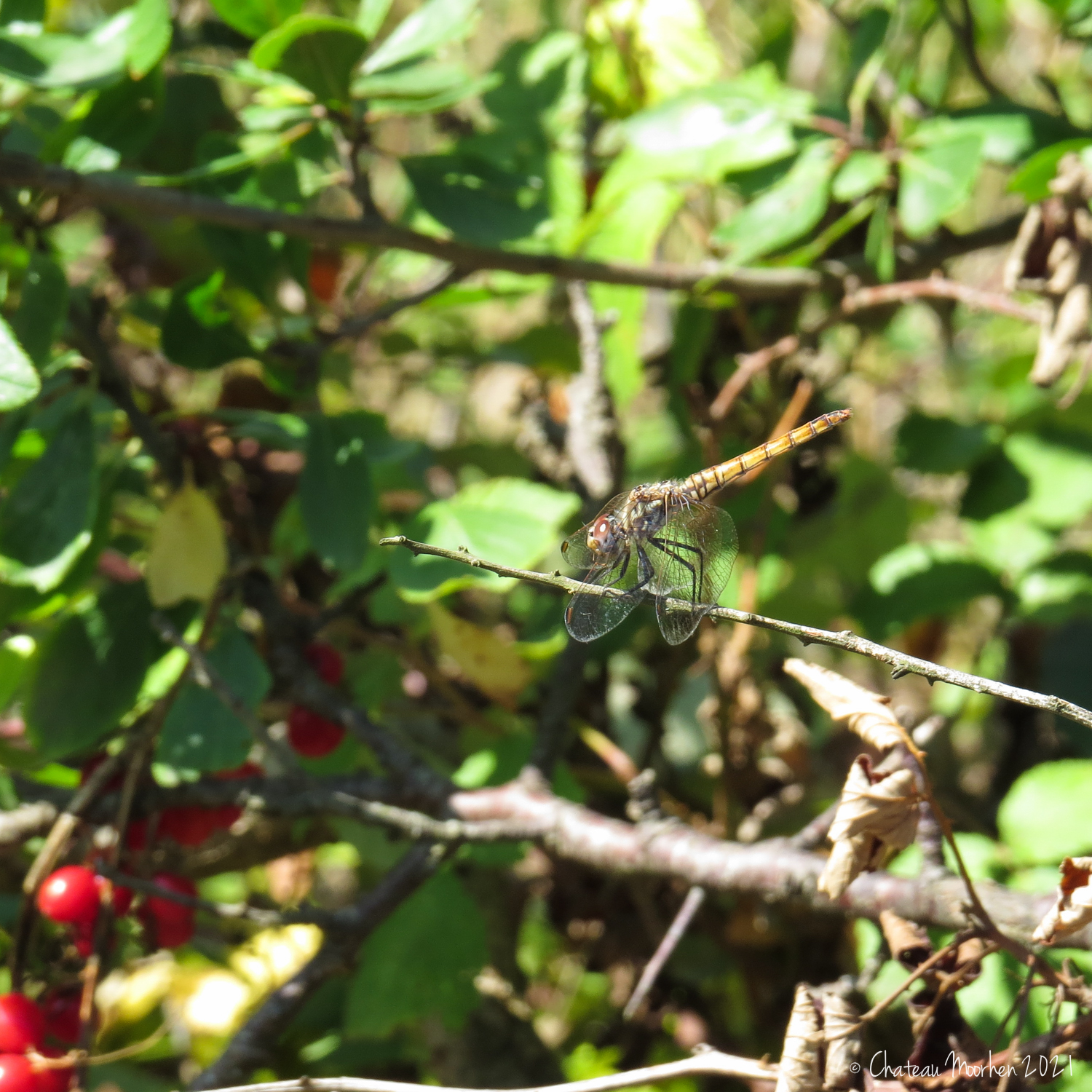
Not my best dragonfly shot and I don't want to spend ages trying to ID it from just one image, so let's just say it's a Darter of some sort, and probably female.

This however is definitely my best shot of a Southern White Admiral (Limenitis reducta)! By this time we had returned to the village of Bugarach and gone for a walk into the fields up above it.


A Grayling of some sort - as there are many species of Grayling on the European mainland I can't ID it from this photo.


A view of the Pic de Bugarach - now from where we live it looks like a nicely mounded peak, but from certain angles it has a fairly jagged flattish top.


This is the first Jersey Tiger Moth (Euplagia quadripunctaria) that I have seen down here - I saw lots of them in Brittany. The small butterfly behind is a Small Heath (Coenonympha pamphilus).


Another daytime flying moth, this time it's one of the Burnet moths, possibly a Five-Spot but the markings are all merged together, so I'm not sure.


We were bird watching as well of course, but apart from a few Wheatears perching on fence posts and telegraph wires, I can't remember what else we saw! Below Wheatear (Oenanthe oenanthe).


Another view of the Pic de Bugarach walking back towards the village.


We then moved on to the Gorge de Galamus to see if there were any migratory birds passing through. We didn't see any, but we were lucky enough to see both a Blue Rock Thrush and a Common Rock Thrush, both in the same place! They were very distant so no photos, but a great find all the same.


I've taken photos of this gorge and the Hermitage of St Antoine before, but the last time I had sun shining through the middle of the shot. This image shows the hermitage much better, and in the next photo which is taken from the main car park, if you view it full size you will see the hermitage in the middle of the image. In this image, you can just see the steps leading up to the chapel built into the cave behind the left and middle roofs.


* We've been having horrible weather, really high winds making the already not very warm weather feel icy, whilst northern France and even the UK bask in sunshine with temps of around 21C and 19C respectively. I'm desperate to get out for a walk as all the plum and now cherry blossoms are out and lots of wildflowers! Keith is braver than me and goes out once a week for a walk no matter what, unless it is raining. I'd rather stay indoors! ๐Ÿ˜€ However Monday is our first trip out with Birding Languedoc this season, so I hope it will be less windy. Orchid season has started and I counted 21 unidentifiable Ophrys genus orchids in the front garden!

* I wrote that several days ago, so yesterday was the day we went out with our birding group! The weather was so much better and between us we have loads of photos from a very successful birding (and wildflower) day, so that will be the next post. ๐Ÿ˜€

Monday, 26 July 2021

Etang de Bagnas and Lesser Kestrels nesting at St Pons de Mauchiens

We are going back to the end of June now for the last outing with Birding Languedoc of their Spring 2021 season. We felt it went out with a bang! We have really enjoyed our trips with them, both last year and this, and have seen innumerable lifers (not just lifer birds!), other wildlife galore and wildflowers to die for. We feel very lucky indeed to have moved here coinciding with them starting to run day trips for the people living here (as well as their more normal birding holidays). For them, with the pandemic arriving, it has been a godsend as it has helped them with a bit of, I'm sure, much needed income!

We started in the morning with a private visit to Etang de Bagnas, a reserve which normally has no public access, but allows accompanied visits. The lake entrance is locked off with a gate, so the public can only stop at the parking and view the lake from this one place. The reserve is one and a half hours from home using the motorway, near the resort town of Agde and close to the Etang de Thau, which runs from Marseillan at one end to the port of Sete at the other.


First we were given a short talk on the history of the reserve by our lovely guide, who I think was enjoying practising her rusty English, with some French thrown in for good measure, which most of us understood. This reserve is fairly surrounded by built up areas and campsites between the reserve and the beach (grey areas on above map), so thankfully this important wetland (dark green and blue areas on map) has not been able to be developed on. We then set off to the lake and walked along one side of it with stops along the way to see what we could see.

What at first seemed like only dozens of coots in fact turned out to be huge numbers of bird life. I know nothing about terns (apart from recognising that a bird is a tern ๐Ÿ˜€) but in fact there were five different species here! I think I saw three of them; they were moving around so fast it was hard to know which was which, especially with the other birds in the sky! We also had not only Common Swifts but Pallid Swifts swooping about overhead. We saw Glossy Ibis flying overhead, and a number of Purple Herons flew past us which I was really chuffed about as I've only ever seen a few of them, many years ago. 


There were Mute Swans (Cygnus olor) and cygnets and a female Pochard (Aythya ferina) with five ducklings, which were so cute to watch! (also in the photo above)


On an island which has a heronry there was a mix of Grey Heron, Great White and Little Egrets and also a juvenile Cattle Egret (on the left of the photo with a fluffy chestnut hairdo!) and a flamboyance of Flamingos (yes really! It's the collective noun which I've only just learned) standing in the water at the edge of it.


Every now and again a Purple Gallinule/Purple Swamphen would appear at the edge of the reeds, which was exciting to see (even though we have seen dozens of them at one place in Spain, and a lot closer up). Well, it was a first for us in France. Even better, a juvenile appeared behind the parent at one point!

I noticed a small blue damselfly so managed to get a few pictures which actually turned out a lot better than I thought they were going to, as my camera was refusing to focus on something so small (it drives me nuts when the SX50 does that). Once home though, I discovered it was a species I had never seen before, the Small Red-eyed Damselfly (Erythromma viridulum)!


Someone else spotted an amazing caterpillar, another lifer for me! This was a Spurge Hawkmoth (Hyles euphorbiae) caterpillar, and although it was already huge, I think it had one more moult to go as the pictures online show it has much more bright red colouring. Here it is eating the stem of what looks like a drying out/dying Euphorbia (commonly called Spurge).


We then went on to the Parc Departementale de Bessilles for our picnic lunch and had a walk around. Our birding guide Karline, who is amazing at spotting Ocellated Lizards, spotted this juvenile peeking out of hole in a dead tree!


After lunch we headed to St Pons de Mauchiens where there is a reintroduced colony of Lesser Kestrels (Falco naumanni) nesting in the roof tiles of the village buildings. This is one of the old villages built on a small hill with a church at the top, 


Credit: Fagairolles 34, CC BY-SA 4.0 <https://creativecommons.org/licenses/by-sa/4.0>, via Wikimedia Commons

From our arrival at the car park to our walk just to the lower town we were already seeing lots of Lesser Kestrels! Luckily for us, they seemed to enjoy perching on gutters and TV aerials with their prey, just sitting around, before they were off to feed their babies. These next photos were taken of a male with a butterfly chrysalis in the lower part of the town.


The most obvious difference between the Lesser Kestrel and the Common Kestrel is the lack of spots/markings on the back of the male Lesser, plus he has grey patches on his wings. Females and juveniles are quite similar, though to help with ID, the two species make different sounds and the Lesser is smaller than the Common.

There was also a male Rock Sparrow (Petronia petronia) on one of the roofs.


We then walked through the village up towards the church at the top of the hill. 


Credit: Keith Allen

We came to a little park area where we could look out over the roofs and the magnificent views beyond, and there was an orientation board naming all the mountains, hills and villages that we could see from there. The Lesser Kestrels were certainly giving us a wonderful display of flying, and posing with their prey. Then suddenly they would disappear under a roof tile to their nests. I did wonder how on earth they could fit under there and just how much space there would be for the nest and growing babies, but there obviously is! Karline, our birding guide, said that if you are there a few weeks later the youngsters come out from the nests and run about on the roofs before they start to fly! We will have to come back and see that next year. 

Male with a cicada:


Another male with unknown grub. We also saw one with a mouse, which it started to eat on the wing!


Female with insect - you can see how easy it is to tell the males from the females.


Credit: Keith Allen

This is where we were viewing the birds from:


The fabulous view beyond the roofs - here we are looking inland to the Haut Languedoc range of mountains:


The Lesser Kestrels were disappearing into their nests under the edge of these roof tiles!

Way off in the distance a Short-toed Snake Eagle (Circaetus gallicus) was spotted - with a snake! Keith managed to get a very distant shot of it, and Philippa from Birding Languedoc was just watching it through her scope when the Eagle "sucked the snake up like it was spaghetti"!! ๐Ÿ˜„


Credit: Keith Allen

One final photo - behind where we were standing watching the birds was this amazing wall - build around huge rocks. If you look closely (click on photo) you can see a couple of tiny windows, one of which has been filled in, so I don't know what is behind, possibly a basement area of the church. It's been patched up and mortared over the years/centuries and is so interesting when you just look at the structure of the building. Shame about the crowd control barrier in the scene but I imagine that's to stop people parking there. 


A full report of this trip with photos is available to read on the Birding Languedoc website, along with a list of species seen (and heard) during the day here. Amazingly it totalled 45 species, not that I saw them all, or some were just a glimpse!

Tuesday, 2 March 2021

We have a pet Hoopoe!

How would you feel if you saw a Hoopoe on your front lawn just as you were turning into your driveway? You'd be excited and amazed - and that even in summer. Now imagine you saw that Hoopoe in your garden in January, when they are supposed to be overwintering in Africa ........ ๐Ÿ˜

Luckily it was spotted again in a neighbouring garden that afternoon so K was able to post a few distant pics of it on facebook, and learned that some Hoopoes do indeed stay around their breeding grounds all year round. I've heard some of them hang around the Med area during winter but we are an hour inland, so it's less likely here. We imagined that first bird was a one off, until last week when I spotted one sitting on our wall beside my herb bed looking somewhat dejected in the drizzle on a miserable day. K got some great shots through the kitchen window, and I got to see it raise its crest when a sparrow landed beside it! Unfortunately, that time K was not there with his camera. (I'm being lazy, as his camera is better than my SX50, and anyway, my camera wasn't to hand at the time).


We were very lucky as a couple of days later it was back again, in the same spot, on a sunny day. This time K got lucky with the camera and captured it raising its crest!


Doesn't its tail look fabulous all splayed out like that - I've not seen that before. Unfortunately when they raise their crests, it's all too brief so of course the only thing you notice is their amazing crest! We haven't seen it again, but even if we don't see one again until the summer, what luck to see one at this time of year, so close by! They aren't exactly common birds - I have only seen about 10 in total, ever. Most of those were in Greece or Spain.

Another exciting bird we saw this winter, funnily enough in almost the same place, was a Sardinian Warbler. Now they do overwinter here, but like the Hoopoe, we aren't seeing them commonly. We didn't get a photo of it as, being a typical Warbler, it was flitting about between the wall and the hedge, and searching around in amongst my parsley. So the photo below is one that K took some years back at a campsite where we were treated to a lovely open view of one, pretty close up.


Aren't they stunning?! The good thing about that red eye is that it is easy to ID them in the field even if they are distant.

In other news, I have received my vaccination! Our doctor seems to have classed me amongst the over 50s with an underlying health condition due to my past cancer. I am not complaining! Unfortunately I got the last dose in the bottle, so K, who was expecting to get his jab as well, will have to wait, although he should get it pretty soon.

PS. Lockdown hair! I did actually cut it twice last summer, with K's help. Then it grew again and I didn't want to go to a hairdresser and I wasn't sure what I wanted to do with my hair, so I just let it grow. Now I can get it in a pony tail! Still unsure what to do. I'll probably get it all cut off again when Covid is a distant memory.


I have some more posts to come (in the mood now!) but will leave you with this slightly shorter than usual post. ๐Ÿ˜€