Blog Header

Blog Header
Showing posts with label Vultures. Show all posts

Saturday, 2 July 2022

Albi, le Rougier de Camares and the vulture museum at the Gorge de la Jonte

I've already shared a few photos from these places but I said I would add some of the interior of Albi cathedral, plus some of Keith's photos of vultures, so here goes.

The Sainte Cécile cathedral at Albi (capital of the Tarn department) was built between the 13th and 15th centuries and the building on the right is a part of the Bishop's Palace, the Palais Episcopal de la Berbi, built before the cathedral itself in a defensive style as the Catholics were at war against the Cathars at this time. It now houses the Toulouse-Lautrec museum.


Whilst I don't have a religious bone in my body, I do appreciate very ornate church and cathedral interiors. Just trying to imagine the work that is involved in the decoration of these places is almost beyond belief! Whether it's the painting, particularly on the ceiling, or the sculptured stonework, they are all equally amazing and the talent involved in those ancient times is sadly mostly lacking in these modern times.


Looking back in the opposite direction.


The amazing ornate ceiling:


Beautiful red stone (marble?) font:


The old bridge, construction of which started in 1040! At one point in the middle ages, it had houses on it, but these were partially destroyed during a flood.


There were dozens of pigeons nesting in amongst the stones!


The new bridge, built in 1868.


The cathedral and Palais de la Berbie from the old bridge:


This building is right beside the old bridge, and I found it fascinating because the base under the patio is so dodgy looking! Not sure I'd want to sit out there. 😀


The collegiate Church of Saint Salvi, built in the 11th century.


On to the Rougier de Camares, weird outcrops of red clay full of iron oxide interspersed with occasional horizontal grey clay strata. It is a very strange valley full of these red patches of earth. Due to the clay, the soil is supposed to be quite moist, which explains the sphagnum moss in many places, but not the wild thyme growing through it!! One likes damp soil, the other dry.


I loved this grass, and found out later that it is Stipa pennata - which like Stipa tenuissima is also called Angel's Hair Grass. Stipa pennata grows across the Causse de Larzac near Millau, in which direction we were heading.


Another attractive wild grass:


We then spent three nights at Millau, a town near the fairly new viaduct de Millau, a motorway bridge across the Tarn river valley near Millau, designed by British architect Norman Foster. There were so many places of interest to visit around here, that we didn't even find time to visit the town itself! We will be back another day.

The first day here we visited the Vulture Museum beside the Gorge de la Jonte, a scenic drive and gorge in itself, even without the vulture interest. I've shown a few photos already but have some vulture photos now to share.


There are four species of vulture that nest around here, but by far the most common are the Griffon Vulture. There is one couple of Black Vultures, a handful of Egyptian Vultures and the Bearded Vulture or Lammergeier which is the rarest. This last we have yet to see.


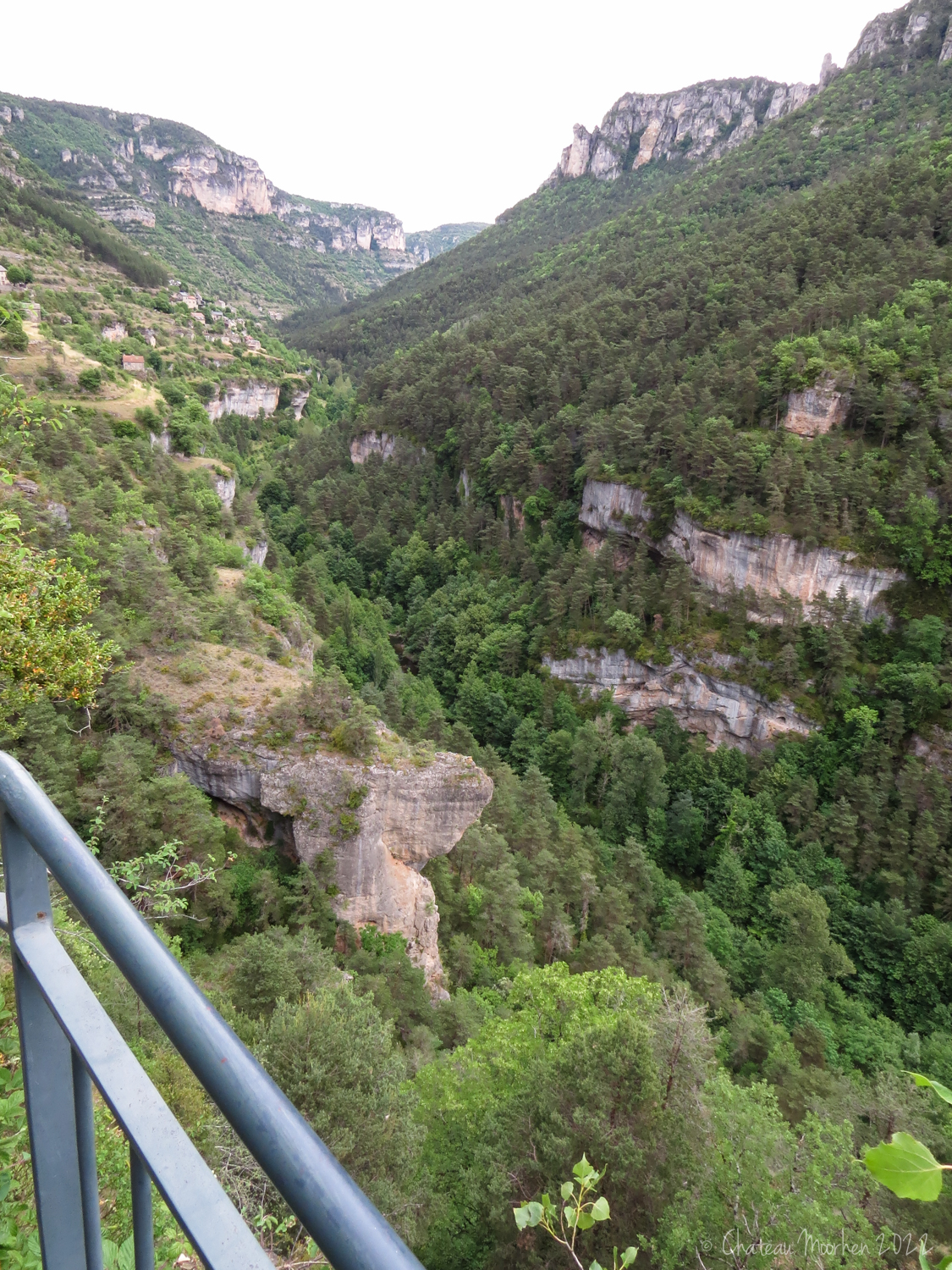
These next images are all taken by Keith with his 800mm lens - as you can see from the image above, the cliff faces were a long way away, and these Griffon Vultures in the photo below are on the same cliffs. My few photos with my SX50 were terrible!


Photo credit: Keith Allen


Photo credit: Keith Allen

On this next photo, you'll need to view it full size as the vulture is the tiny looking bird right in the centre of the image! It's actually a Black (or Monk) Vulture (Aegypius monachus), much rarer than the Griffon Vultures and in fact there is only one pair nesting in this area this year; how lucky they chose to build their nest in full view of the viewing platform! They are the only vultures that build nests in trees. It's not in the photo but we could see the youngster's little head bobbing up and down - apparently it was about six weeks old.


Photo credit: Keith Allen

Back to the Griffon Vultures (Gyps fulvus):


Photo credit: Keith Allen


Photo credit: Keith Allen

Back soon I hope with more holiday photos!

Tuesday, 29 March 2022

International Vulture Day 4 September 2021

Yes I am going back a bit! I never wrote about vulture day in 2020 as it was soooo cold that morning I didn't even take any photos - this time I was better prepared with a warmer jacket and gloves but luckily it was much warmer anyway, so I was able to take photos galore! There is a vulture watching spot at the base of the mini mountain of Bugarach, the highest peak in the Corbières at 1,230m. In the past the LPO (French equivalent of RSPB) used to feed the vultures more often and you could find out when they were planning to do it, so could go along, but now for some reason or other they only do this once a year on International Vulture Day. Nonetheless, there are often vultures hanging around in this area, and so you can see them at other times. There are information boards telling you about all the different species of vulture that you may be lucky to see, although by far the most common is the Griffon Vulture. I have seen two other species of vulture elsewhere in France and in Spain, but only the Griffon on these days at Bugarach. It's not disappointing though as any vulture is worth watching, in my opinion!. The only sad thing about this place is that the feeding platform is way across a valley so is rather distant for photos - a good thing they are big birds!

First of all, when we arrived we were lucky to see these Chamois perched up on the ridge - we've never seen them before so that was a real bonus. I think for this and the vulture shots, you would be better to click on the photos and view them full size.


It seems that maybe a few vultures who are sitting around or flying around notice what is going on (i.e. a pickup truck with a load of offal) and in no time at all, others start appearing and swoop around the skies until the time when the meat is put down, then whoosh! Seeing them come into land and then start squabbling over the meat is quite a sight, all the while there are crows trying to get in there to get a morsel or two as well!


I think most of the food had gone by this time as they are looking up, maybe hoping for seconds? 😀


Griffons are large vultures, with a wingspan of 2.3–2.8 m (7.5–9.2 ft) (according to Wikipedia). And here is what they really look like in this beautiful photograph by Pierre Dalous taken from the Wikipedia page for Griffon Vultures. How I wish I could get a shot like this!

Gypful.jpg

Once the birds had finished their meal they took to the skies and we continued to watch them for a while, as it is rare to see so many in the skies all at once, except for at feeding time!


Philippa (on the right) who is the owner/leader of Birding Languedoc and some of our group watching the vultures.


The day was not over as we went to a pretty picnic lake on the outskirts of the village of Bugarach to eat our picnic lunch.


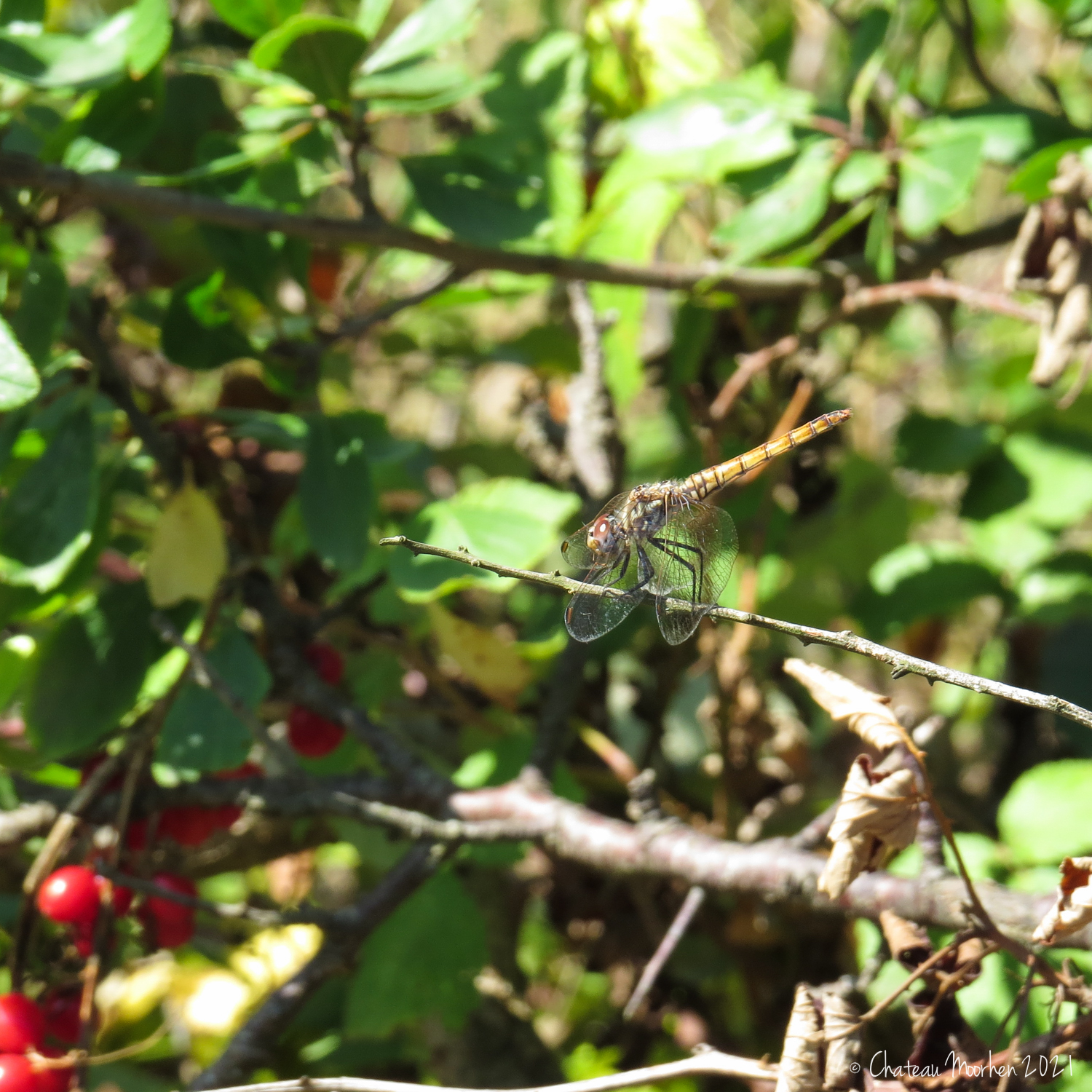
Not my best dragonfly shot and I don't want to spend ages trying to ID it from just one image, so let's just say it's a Darter of some sort, and probably female.


This however is definitely my best shot of a Southern White Admiral (Limenitis reducta)! By this time we had returned to the village of Bugarach and gone for a walk into the fields up above it.


A Grayling of some sort - as there are many species of Grayling on the European mainland I can't ID it from this photo.


A view of the Pic de Bugarach - now from where we live it looks like a nicely mounded peak, but from certain angles it has a fairly jagged flattish top.


This is the first Jersey Tiger Moth (Euplagia quadripunctaria) that I have seen down here - I saw lots of them in Brittany. The small butterfly behind is a Small Heath (Coenonympha pamphilus).


Another daytime flying moth, this time it's one of the Burnet moths, possibly a Five-Spot but the markings are all merged together, so I'm not sure.


We were bird watching as well of course, but apart from a few Wheatears perching on fence posts and telegraph wires, I can't remember what else we saw! Below Wheatear (Oenanthe oenanthe).


Another view of the Pic de Bugarach walking back towards the village.


We then moved on to the Gorge de Galamus to see if there were any migratory birds passing through. We didn't see any, but we were lucky enough to see both a Blue Rock Thrush and a Common Rock Thrush, both in the same place! They were very distant so no photos, but a great find all the same.


I've taken photos of this gorge and the Hermitage of St Antoine before, but the last time I had sun shining through the middle of the shot. This image shows the hermitage much better, and in the next photo which is taken from the main car park, if you view it full size you will see the hermitage in the middle of the image. In this image, you can just see the steps leading up to the chapel built into the cave behind the left and middle roofs.


* We've been having horrible weather, really high winds making the already not very warm weather feel icy, whilst northern France and even the UK bask in sunshine with temps of around 21C and 19C respectively. I'm desperate to get out for a walk as all the plum and now cherry blossoms are out and lots of wildflowers! Keith is braver than me and goes out once a week for a walk no matter what, unless it is raining. I'd rather stay indoors! 😀 However Monday is our first trip out with Birding Languedoc this season, so I hope it will be less windy. Orchid season has started and I counted 21 unidentifiable Ophrys genus orchids in the front garden!

* I wrote that several days ago, so yesterday was the day we went out with our birding group! The weather was so much better and between us we have loads of photos from a very successful birding (and wildflower) day, so that will be the next post. 😀

Thursday, 8 October 2020

The Aude river flood plain and International Vulture Day

Aude River Flood Plain

We're going back to the 6th August here and we learned of this birding site through the Birding Languedoc group who organised a small outing here after lockdown was lifted. We were due to go but eventually didn't as Keith had a bad cough that developed not long after lockdown (eeeeks!!!) and just got worse and worse; it did turn chesty as well as being dry, but even so was a bit of a worry. Thankfully it turned out to be bronchitis but before he knew for sure we had to cancel, as we didn't want to worry other people or take the risk of infecting them. Sadly there were two outings that we missed - the other we need a 4 wheel drive to do but will visit next spring as it will be too muddy from all the rain we've had and are due to get. This place however we were able to do in a regular car, just a few months later than planned.

As usual we picked a hot day, but every day was hot back then and temps were in the low 30s so manageable! Interesting birds seen down here near where the Aude river runs out to the sea are Bee-eaters, Rollers and Golden Orioles. We managed two out of the three although the Golden Orioles were juveniles flying overhead so it was a brief sighting, though we did hear an adult singing/calling in the direction where they were flying. We also saw several Woodchat Shrikes which was pretty cool, however the star of the day were the Bee-eaters.


There are two Bee-eaters in this photo - my eye is always drawn to the bottom one, perhaps as it shows more blue?


Keith's photos were better than mine as his Nikon bridge camera has a massive zoom lens and he is also extremely steady on his feet.

There were lots of Bee-eaters all flying around in groups. One thing we learned about them which is great for photographers and bird watchers alike, is that they seem to love perching in dead trees!


We walked downhill from where we parked down along beside two overgrown  paddocks with occasional trees in the fields, as well as low trees and shrubs edging them, which is where the Bee-eaters and Shrikes were flying and perching.


Woodchat Shrike


The above is my pic of a Woodchat Shrike, but the bird was quite distant so I was quite pleased with it.


Me chilling in the lovely cool wind blowing from the Aude river, sorry my vaper is in the picture, I try to avoid that as much as I used to avoid being photographed with a cigarette in my hand when they became antisocial..... but I didn't know my photograph was being taken!


The above and next photos show where we went - above are the vines on the flat land (flood plain) running from the river to this hill, which is the very edge of the limestone ridge known as La Clape, which starts one end near Narbonne and ends here where the Aude river hits the sea. In the photo below which was taken from the road leading down to river level, shows the two horizontal paddocks in the foreground where the Bee-eaters were flying up and down, with the vinyards behind in perfectly straight fields with occasional roads or irrigation channels running in between. We didn't see any Bee-eaters in amongst the vines or closer to the river.


All in all a very successful day out birding and we came home glowing, in several senses of the word! 😀😄

Vultures

I don't want to get your hopes up expecting to see lots of pictures of vultures but sadly this day was the complete opposite of the one above. It was, perhaps not literally, but it jolly well felt it, freezing! We met the others (it was another Birding Languedoc jolly) at 8.45am in the car park by the vulture viewing/information area. The trip had been organised because it was International Vulture Day and the LPO had arranged to feed the vultures and give a talk about them. I don't know how many years this has been going on for but the lady who runs BL said they went last year (and saw an Egyptian Vulture amongst the many Griffon Vultures). Apparently the LPO don't feed the vultures here any more with any regularity which is a shame as I had been hoping to find out when they were going to do it next so that we could go along. Never mind because we got to see it after all! We had been lucky enough to witness a vulture feeding quite by chance at a very similar place in northern Spain one holiday so we had an idea what to expect.

Before I go on I just want to say that I didn't take a single photo; I was SO cold that my hands went numb from looking through binocs and after the main feast was over I left before the LPO guy had finished his talk and went and sat in the car. The temp was about 13C which was a huge shock to the system after a summer where the coolest day we'd had was about 25C and that felt quite cool, especially if it was windy. I did have a fleece on and a waterproof jacket on top but a winter jacket and gloves would have been more suitable.

Luckily K took a couple of photos from which you can get the picture. There's an area where the birds are fed (and obviously have long memories as we have seen some hanging around here on a previous visit minus food) then there's the area where everyone stands around watching, which is quite far away, but OK with binocs and even better with a spotting scope, which we have now. A couple of guys went over to the feeding area in a van and dumped a load of raw meat - it didn't look like a lot but was apparently 25kg. Then we all waited, as the vultures started to circle and more and more arrived. Then they descended and got stuck in, fighting over the juicy morsels of butchers' offcuts, whilst yet more vultures kept appearing over the mountain behind. On this day they were all Griffon Vultures which are the most common species, but there are also more rarely seen the Egyptian Vulture and the Bearded Vulture or Lammergeier.  It's a sight well worth seeing even if you are not a birder, much as non birders will enjoy a falconry display. Of course, this was a bit more gory, but you are not (sadly) seeing it very close up! When we saw vulture feeding in Spain we saw one Egyptian Vulture and several Red Kites, and from that site you are looking down into the valley where they circle towards the feeding spot, rather than looking at them up against the sky. Looking down is a lot better as you are not seeing the birds silhouetted against the sky.


Putting meat out for the vultures


Griffon Vultures fighting over said meat!


Gorges de Galamus

These gorges are not far from Bugarach and we went here to see if there were any birds migrating through the gorge, but it was not to be. Although the temps had warmed up somewhat it was very windy at the parking spot which is very exposed, so we sat in our cars to eat lunch, with magnificent scenery all around. Some of the group had already left after the vulture feeding (it was a free day trip) and a couple more left after we stopped at a cafe for a much needed warming chocolat chaud. I really enjoyed our time at the cafe as we talked birds, birdwatching and places to watch birds and nothing but - lovely for Keith and me as it's a very specific hobby and not something we talk about with friends other than general garden bird type of chat.

After saying goodbye to the others at the gorge we drove home on a scenic route that took us through the gorgeous Fenouillèdes and up past the chateaux of Quéribus and Peyrepertuse. The road (D19) that leads from Maury in the valley to these chateaux is, in my opinion, the most scenic road I've ever seen, but now I know you have to be driving down it, not up. I kept having to look behind me to see the amazing view at its best! (don't worry, I wasn't driving! 😂😂😂)


This is the hermitage Saint-Antoine built on the side of the gorge which we visited some years ago. We walked about half an hour from the main car park to it, but once there, found that you could go up some steps to a smaller car park right above!! 😂


On our way home we stopped to take a photo of the Chateau de Peyrepertuse from below the village. It's not that easy to make out what is chateau and what is just rock from this distance and angle! There is a second part of the castle higher above the first one, too.


The following is a picture from when we visited and climbed up to the top of the chateau in 2017. That's our Moho parked down below, then you take a woodland path that goes behind the chateau, which is nowhere near as steep as you would imagine! If I can make it up there, anyone can. 😀


Chateau de Peyrepertuse in 2017


******************


Phew, sorry this has ended up being long! It's also taken me AGES to do with this new Blogger format; it's really driving me potty with the strange things the html is doing. I did try using the new caption feature (which is hard to find) but didn't like it, but don't care too much for just centering text under trying to make it look like a caption either. Oh well. Least I know everyone else is in the same boat!