This is a continuation from Part 1 here.
Here we are looking where the River Briant - where I am standing on the left of the photo - meets the River Cesse coming in from the right side of the photo and it flows off towards where K is taking the photo behind me.
Photo credit: Keith Allen
We then went back down into the river bed to go and explore the tunnel where the water normally flows. I liked the view below where you can see the different architecture - old concrete blocks for the lower path with an interesting (!!) concrete block to hold it up, and a much more aesthetically pleasing dry stone wall for the upper path/top of village. As well as this you can see where the river has worn away at the rocks over time and the streaks where different minerals have stained the rocks are interesting too (unless it's all lichen, or both?) - in some parts of the path above (photo with K) there is water constantly dripping through the rocks - I hope that's not from someone's drains leaking! 😀 It must be a very old path as the stone floor is worn really smooth and shiny, like marble.
The Candela tower seen through the viaduct bridge.
The tunnel known as the 'Pont Naturel'
Photo credit: Keith Allen
This stone stacking seems to be very popular everywhere we go, and in fact in Google Maps for this place there are tons of photos of stacked stones all over the dry river bed! Seems like nobody did that this year except for here on the bank.
Light at the end of the tunnel! We didn't walk all the way to the end as it was pretty rough under foot, but now I wish that we had done so, as I discovered from a footpath map that the river flows into another shorter tunnel, before it comes out and continues on as the Cesse gorge. There was a little bat flying around, though whether we had disturbed it or not, I don't know.
Some people were walking into the tunnel just at the right time, for scale!
Looking back at the entrance to the Pont Naturel from the footpath.
It's worth looking up occasionally too, as I spotted these Prickly Pear cacti growing wild out of the rocks.
Another view of the Candela tower and the entrance to the village from the main car park.
We walked past this fun little garden full of interesting things, including the lovely 'driftwood' log and the colourful planted up teapot.
Back in the village at the War Memorial where the wilting flowers must be left from Remembrance Day. The sign on the left says, 'Please don't cut the flowers'. Bit of a shame to need to have a sign telling people that, as presumably some horrible people do.
Last photo! I don't think Minerve village itself is particularly attractive although it is one of the "Plus Belles Villages de France" (Most Beautiful Villages in France). I think that's because the whole place, scenery too, is so stunning. There are a few restaurants and cafes here but in winter it is generally very quiet, though good to know that this bookshop/cafe is open all year round. La Terrasse restaurant was open a couple of years ago when we visited before Xmas with my brother, but who knows what is still open after Covid has hit so hard?
This is a fabulous short aerial video of Minerve and the surrounding gorges which puts my walk into perspective - and as I haven't got any photos from further away up the gorges I can't show you it in all its magnificence that way. I don't seem to be able to make the video embed larger though so I hope you can view it bigger on your computer/phone/whatever. If not, this is the link on Youtube, although that seems to be a 26 min video, which must have been a TV programme. Enjoy. 😀
Blog Header
Showing posts with label Minerve. Show all posts
Monday, 6 December 2021
Wednesday, 1 December 2021
Minerve and its amazing river gorge Part 1
We had a few days recently when the weather was forecast to be wall to wall sunshine with no wind, so we immediately planned to go out. Even better, we took Mary Moho out for a long overdue spin. Although we have been here several times before, Minerve is well worth visiting again and again, and we know that we can park a motorhome in the large public parking at any time of the year.
The only thing that disappointed me about the day is that I was hoping to get lots of photos of lovely autumn leaves, only to realise as we got closer that the green hills that we were heading towards were in fact covered in evergreen flora! It's all garrigue type of vegetation around here, with just a few deciduous trees here and there, particularly growing down at river level.
You can't drive into the village but the walk from the parking is not far and is very scenic so expect it to take twice as long as you would have thought!
May I suggest that you view all these photos larger by clicking on them as they don't show as sharply like this as when you see them full size.
Minerve from the car park, where we had lunch first.
Minerve is perched up on a cliff above two rivers which meet here, the Briant and the Cesse. Over the millennia they have carved their way through the rocks leaving some amazing shapes where the rock has been worn away, and on one side of the village, the Cesse river disappears into a cave/tunnel called the 'Pont Naturel' ('Natural Bridge'); it comes out into the open for a short distance before disappearing into another shorter tunnel.
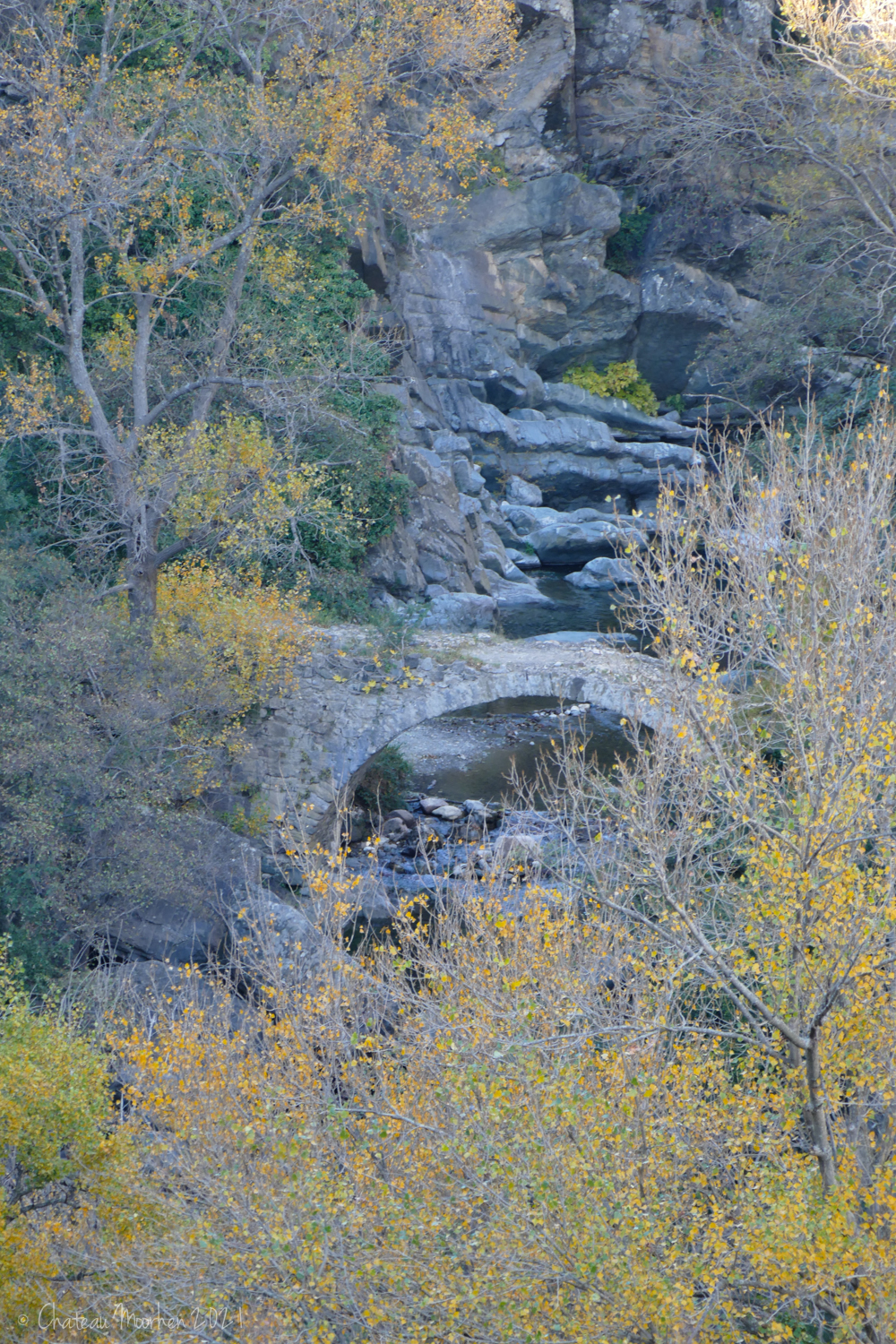
This next photo is very zoomed in, looking towards the left down the above gorge, where you can see the old Roman Bridge. Funnily enough, there is some water here (the Briant river), yet further along where we went down to the river bed, it was dry.
There's some interesting bird life around here, and in winter it is well known as a place where Wallcreepers can be found. There are also Rock Sparrows, which perch up on the roofs of the buildings, and Crag Martins, which swoop around over the village and perch on the sides of the bridge. Whilst we were scanning with our binocs Keith suddenly spotted a Wallcreeper! This is only the second one we have ever seen, but unfortunately it too was the other side of a gorge, so not exactly easy to watch or photograph! We didn't have the spotting scope with us as we planned on a nice walk around, and K didn't bring his new long lens (on his new Canon dslr), and I had my Lumix bridge as I thought I was going to be taking photos of scenery, not distant birds!
So, can you spot the Wallcreeper in the following zoomed in to the max 400mm optical lens of my Lumix? 😀😂😀
I can just see it, but then I know where it was. 😀 The following photo is zoomed in to max digitally, which is of course dreadful, but it's a record shot. If you look in the middle of the image on the vertical grey patch, the bird is a grey bird looking upwards with a black stripe down its side (along the wing edge). If you should ever get to see them closer up, or preferably in flight, they have amazing red feathers under their wings, but like this you can't see the colour. One good thing about Wallcreepers is that they flit about a lot on the rock face, so the movement helps to find them.
This tower is called La Candela and is the remains of an ancient chateau which was reconstructed in the 13th century. So, a new building then. 😀
The walking tour which I'm taking you on goes to the left of the village around the ramparts and down into the dry river bed, then we come back up into the village around where the viaduct bridge is.
There's been a new footpath under construction the last two years but it is finally finished, so we enjoyed seeing this side of the town from a different angle. The first thing which stood out was this building, sitting on a very interesting 'foundation'! 😀 I think from the street side it just looks like any other old stone village house, but I wouldn't fancy going in it! They have cut back the vines but the upstairs window looks like it needs a bit of work doing to it. Or maybe that IS the work? 😂
I would also find this pillar a bit worrying, as I assume it's there to help hold up the buildings....😱
Looking back to the start of the new footpath, the house with the dodgy foundations and the new planting, which I like very much (very similar to my new Pollinator Bed). I love the wild grass here - at least it looks wild to me, rather than something which has been planted, unless they have specifically sown it for the rippling effect of the grass flowers.
I don't have a wide enough angle lens to fit it all in, so here's the gorge again above the river Briant (also known as Brian, but pronounced the same in French anyway).
Now we turn around and look forward again. This is a replica of one of the four Trebuchets which attacked the village; this one in particular called la Malvoisine, was aiming for the town well. A trebuchet is a giant catapault and was a medieval weapon. There is a huge amount of history to Minerve, much relating to the Cathars who were a weirdo offshoot of Catholicism, persecuted by the Catholic Church during what became known as the Albigensian Crusade. Cathars are the people who built all the defensive castles perched up on rocks dotted about through much of our department, Aude. In a nutshell, Simon de Montfort beseiged Minerve back in 1210 and when he eventually destroyed the town's well, they had no choice but to surrender. Negotiations ensued to save the townsfolk, but the 140 Cathars refused to renounce their faith so were burned at the stake in the village square. Nice one, Simon.
This was the first time we have seen the riverbeds completely dry, as we have visited before in February and in December, I think another time too, and each time there has been water running into the tunnel. Of course, we had to go down and walk on the riverbed to experience it!
I know this is a bit of a small image of a butterfly, but for the record, it was so lovely to see some butterflies again! This Clouded Yellow stopped near me very briefly, and we also saw some Whites, a few Red Admirals and a Small Copper. Down in the gorge and in the village there were still plenty of flowers, so I imagine it is very mild and sheltered here during winter.
The only thing that disappointed me about the day is that I was hoping to get lots of photos of lovely autumn leaves, only to realise as we got closer that the green hills that we were heading towards were in fact covered in evergreen flora! It's all garrigue type of vegetation around here, with just a few deciduous trees here and there, particularly growing down at river level.
You can't drive into the village but the walk from the parking is not far and is very scenic so expect it to take twice as long as you would have thought!
May I suggest that you view all these photos larger by clicking on them as they don't show as sharply like this as when you see them full size.
Minerve from the car park, where we had lunch first.
Minerve is perched up on a cliff above two rivers which meet here, the Briant and the Cesse. Over the millennia they have carved their way through the rocks leaving some amazing shapes where the rock has been worn away, and on one side of the village, the Cesse river disappears into a cave/tunnel called the 'Pont Naturel' ('Natural Bridge'); it comes out into the open for a short distance before disappearing into another shorter tunnel.
This next photo is very zoomed in, looking towards the left down the above gorge, where you can see the old Roman Bridge. Funnily enough, there is some water here (the Briant river), yet further along where we went down to the river bed, it was dry.
There's some interesting bird life around here, and in winter it is well known as a place where Wallcreepers can be found. There are also Rock Sparrows, which perch up on the roofs of the buildings, and Crag Martins, which swoop around over the village and perch on the sides of the bridge. Whilst we were scanning with our binocs Keith suddenly spotted a Wallcreeper! This is only the second one we have ever seen, but unfortunately it too was the other side of a gorge, so not exactly easy to watch or photograph! We didn't have the spotting scope with us as we planned on a nice walk around, and K didn't bring his new long lens (on his new Canon dslr), and I had my Lumix bridge as I thought I was going to be taking photos of scenery, not distant birds!
So, can you spot the Wallcreeper in the following zoomed in to the max 400mm optical lens of my Lumix? 😀😂😀
I can just see it, but then I know where it was. 😀 The following photo is zoomed in to max digitally, which is of course dreadful, but it's a record shot. If you look in the middle of the image on the vertical grey patch, the bird is a grey bird looking upwards with a black stripe down its side (along the wing edge). If you should ever get to see them closer up, or preferably in flight, they have amazing red feathers under their wings, but like this you can't see the colour. One good thing about Wallcreepers is that they flit about a lot on the rock face, so the movement helps to find them.
This tower is called La Candela and is the remains of an ancient chateau which was reconstructed in the 13th century. So, a new building then. 😀
The walking tour which I'm taking you on goes to the left of the village around the ramparts and down into the dry river bed, then we come back up into the village around where the viaduct bridge is.
There's been a new footpath under construction the last two years but it is finally finished, so we enjoyed seeing this side of the town from a different angle. The first thing which stood out was this building, sitting on a very interesting 'foundation'! 😀 I think from the street side it just looks like any other old stone village house, but I wouldn't fancy going in it! They have cut back the vines but the upstairs window looks like it needs a bit of work doing to it. Or maybe that IS the work? 😂
I would also find this pillar a bit worrying, as I assume it's there to help hold up the buildings....😱
Looking back to the start of the new footpath, the house with the dodgy foundations and the new planting, which I like very much (very similar to my new Pollinator Bed). I love the wild grass here - at least it looks wild to me, rather than something which has been planted, unless they have specifically sown it for the rippling effect of the grass flowers.
I don't have a wide enough angle lens to fit it all in, so here's the gorge again above the river Briant (also known as Brian, but pronounced the same in French anyway).
Now we turn around and look forward again. This is a replica of one of the four Trebuchets which attacked the village; this one in particular called la Malvoisine, was aiming for the town well. A trebuchet is a giant catapault and was a medieval weapon. There is a huge amount of history to Minerve, much relating to the Cathars who were a weirdo offshoot of Catholicism, persecuted by the Catholic Church during what became known as the Albigensian Crusade. Cathars are the people who built all the defensive castles perched up on rocks dotted about through much of our department, Aude. In a nutshell, Simon de Montfort beseiged Minerve back in 1210 and when he eventually destroyed the town's well, they had no choice but to surrender. Negotiations ensued to save the townsfolk, but the 140 Cathars refused to renounce their faith so were burned at the stake in the village square. Nice one, Simon.
This was the first time we have seen the riverbeds completely dry, as we have visited before in February and in December, I think another time too, and each time there has been water running into the tunnel. Of course, we had to go down and walk on the riverbed to experience it!
I know this is a bit of a small image of a butterfly, but for the record, it was so lovely to see some butterflies again! This Clouded Yellow stopped near me very briefly, and we also saw some Whites, a few Red Admirals and a Small Copper. Down in the gorge and in the village there were still plenty of flowers, so I imagine it is very mild and sheltered here during winter.
I will continue in Part 2 as I have a lot more photos!
P.S. We had a sprinkling of snow yesterday morning!!!
Part 2 is here.
Subscribe to:
Posts (Atom)