Or to give Beziers' gothic cathedral its full name - Cathédrale Saint-Nazaire-et-Saint-Celse de Béziers - was built from the 13th to 15th centuries on the remains of an older romanesque church that was destroyed during the massacre of Beziers by the Albigensian Crusaders on 22nd July 1209.
The cathedral and old part of the town are situated on a high point overlooking the Orb river and the cathedral can be seen from far away.
Raimond Roger Trencavel (below) was viscount of Beziers and Carcassonne and lived at the same time as the crusade against the Cathars. When the Albigensian crusade was on its way towards Beziers, Albi and Carcassonne with 10,000 men, Raimond Roger tried to do a deal with the crusaders, but they refused to meet with him. He fled to the fortified city of Carcassonne which was subsequently surrounded and its drinking water cut off. When Carcassonne surrendered, the people were forced to leave but after receiving safe passage in order to negotiate the surrender, Raimond Roger was then captured and thrown into a dungeon, where he eventually died.
Beziers, however, didn't get off so lightly. The cathedral was destroyed and the thousands of townsfolk were massacred.
The beautiful organ pipes and stained glass circular window, above and below.
The cloister, above and below, has apparently never been finished due to a lack of funding. It looks OK to me!
I really wanted to go up the 149 steps to the roof and my brother came with me. It was all via circular staircase with a break at mid level where there is a balcony inside the cathedral. It got a bit dodgy when meeting people coming down! Keith didn’t want to come but given his size he would have found it pretty tight in there. It was fairly tough and most people were puffing and panting and taking breathers, like me!
We didn’t go all the way to the very top (it was barred off) but came out where there was a small walkway on all four sides of the tower. On this sunny day the views were amazing.
I was using my phone and am surprised my photos came out so well as it was literally point and shoot as I couldn’t see anything on the screen!
Looking down to the Orb river and the old bridge dating from the 12th century on the right, which is not used for vehicles.
Looking inland towards the Montagne Noir. I could actually see the sea from up here.
My brother showing how narrow it was in most places up there!
Once down we walked around to this garden which had a lovely view and where we could even feel some warmth from the sun, despite the temp being about 11C. The trees are all citrus trees but without any fruit on. It was a lovely place to just sit and chill for a bit.
Next Xmas we plan to visit Perpignan in neighbouring Pyrenees-Orientales department, then we will have finally been to all the main towns around here. 😄
Blog Header
Showing posts with label outings Herault. Show all posts
Wednesday, 15 January 2025
Monday, 6 December 2021
Minerve and its amazing river gorge Part 2
This is a continuation from Part 1 here.
Here we are looking where the River Briant - where I am standing on the left of the photo - meets the River Cesse coming in from the right side of the photo and it flows off towards where K is taking the photo behind me.
Photo credit: Keith Allen
We then went back down into the river bed to go and explore the tunnel where the water normally flows. I liked the view below where you can see the different architecture - old concrete blocks for the lower path with an interesting (!!) concrete block to hold it up, and a much more aesthetically pleasing dry stone wall for the upper path/top of village. As well as this you can see where the river has worn away at the rocks over time and the streaks where different minerals have stained the rocks are interesting too (unless it's all lichen, or both?) - in some parts of the path above (photo with K) there is water constantly dripping through the rocks - I hope that's not from someone's drains leaking! 😀 It must be a very old path as the stone floor is worn really smooth and shiny, like marble.
The Candela tower seen through the viaduct bridge.
The tunnel known as the 'Pont Naturel'
Photo credit: Keith Allen
This stone stacking seems to be very popular everywhere we go, and in fact in Google Maps for this place there are tons of photos of stacked stones all over the dry river bed! Seems like nobody did that this year except for here on the bank.
Light at the end of the tunnel! We didn't walk all the way to the end as it was pretty rough under foot, but now I wish that we had done so, as I discovered from a footpath map that the river flows into another shorter tunnel, before it comes out and continues on as the Cesse gorge. There was a little bat flying around, though whether we had disturbed it or not, I don't know.
Some people were walking into the tunnel just at the right time, for scale!
Looking back at the entrance to the Pont Naturel from the footpath.
It's worth looking up occasionally too, as I spotted these Prickly Pear cacti growing wild out of the rocks.
Another view of the Candela tower and the entrance to the village from the main car park.
We walked past this fun little garden full of interesting things, including the lovely 'driftwood' log and the colourful planted up teapot.
Back in the village at the War Memorial where the wilting flowers must be left from Remembrance Day. The sign on the left says, 'Please don't cut the flowers'. Bit of a shame to need to have a sign telling people that, as presumably some horrible people do.
Last photo! I don't think Minerve village itself is particularly attractive although it is one of the "Plus Belles Villages de France" (Most Beautiful Villages in France). I think that's because the whole place, scenery too, is so stunning. There are a few restaurants and cafes here but in winter it is generally very quiet, though good to know that this bookshop/cafe is open all year round. La Terrasse restaurant was open a couple of years ago when we visited before Xmas with my brother, but who knows what is still open after Covid has hit so hard?
This is a fabulous short aerial video of Minerve and the surrounding gorges which puts my walk into perspective - and as I haven't got any photos from further away up the gorges I can't show you it in all its magnificence that way. I don't seem to be able to make the video embed larger though so I hope you can view it bigger on your computer/phone/whatever. If not, this is the link on Youtube, although that seems to be a 26 min video, which must have been a TV programme. Enjoy. 😀
Here we are looking where the River Briant - where I am standing on the left of the photo - meets the River Cesse coming in from the right side of the photo and it flows off towards where K is taking the photo behind me.
Photo credit: Keith Allen
We then went back down into the river bed to go and explore the tunnel where the water normally flows. I liked the view below where you can see the different architecture - old concrete blocks for the lower path with an interesting (!!) concrete block to hold it up, and a much more aesthetically pleasing dry stone wall for the upper path/top of village. As well as this you can see where the river has worn away at the rocks over time and the streaks where different minerals have stained the rocks are interesting too (unless it's all lichen, or both?) - in some parts of the path above (photo with K) there is water constantly dripping through the rocks - I hope that's not from someone's drains leaking! 😀 It must be a very old path as the stone floor is worn really smooth and shiny, like marble.
The Candela tower seen through the viaduct bridge.
The tunnel known as the 'Pont Naturel'
Photo credit: Keith Allen
This stone stacking seems to be very popular everywhere we go, and in fact in Google Maps for this place there are tons of photos of stacked stones all over the dry river bed! Seems like nobody did that this year except for here on the bank.
Light at the end of the tunnel! We didn't walk all the way to the end as it was pretty rough under foot, but now I wish that we had done so, as I discovered from a footpath map that the river flows into another shorter tunnel, before it comes out and continues on as the Cesse gorge. There was a little bat flying around, though whether we had disturbed it or not, I don't know.
Some people were walking into the tunnel just at the right time, for scale!
Looking back at the entrance to the Pont Naturel from the footpath.
It's worth looking up occasionally too, as I spotted these Prickly Pear cacti growing wild out of the rocks.
Another view of the Candela tower and the entrance to the village from the main car park.
We walked past this fun little garden full of interesting things, including the lovely 'driftwood' log and the colourful planted up teapot.
Back in the village at the War Memorial where the wilting flowers must be left from Remembrance Day. The sign on the left says, 'Please don't cut the flowers'. Bit of a shame to need to have a sign telling people that, as presumably some horrible people do.
Last photo! I don't think Minerve village itself is particularly attractive although it is one of the "Plus Belles Villages de France" (Most Beautiful Villages in France). I think that's because the whole place, scenery too, is so stunning. There are a few restaurants and cafes here but in winter it is generally very quiet, though good to know that this bookshop/cafe is open all year round. La Terrasse restaurant was open a couple of years ago when we visited before Xmas with my brother, but who knows what is still open after Covid has hit so hard?
This is a fabulous short aerial video of Minerve and the surrounding gorges which puts my walk into perspective - and as I haven't got any photos from further away up the gorges I can't show you it in all its magnificence that way. I don't seem to be able to make the video embed larger though so I hope you can view it bigger on your computer/phone/whatever. If not, this is the link on Youtube, although that seems to be a 26 min video, which must have been a TV programme. Enjoy. 😀
Wednesday, 1 December 2021
Minerve and its amazing river gorge Part 1
We had a few days recently when the weather was forecast to be wall to wall sunshine with no wind, so we immediately planned to go out. Even better, we took Mary Moho out for a long overdue spin. Although we have been here several times before, Minerve is well worth visiting again and again, and we know that we can park a motorhome in the large public parking at any time of the year.
The only thing that disappointed me about the day is that I was hoping to get lots of photos of lovely autumn leaves, only to realise as we got closer that the green hills that we were heading towards were in fact covered in evergreen flora! It's all garrigue type of vegetation around here, with just a few deciduous trees here and there, particularly growing down at river level.
You can't drive into the village but the walk from the parking is not far and is very scenic so expect it to take twice as long as you would have thought!
May I suggest that you view all these photos larger by clicking on them as they don't show as sharply like this as when you see them full size.
Minerve from the car park, where we had lunch first.
Minerve is perched up on a cliff above two rivers which meet here, the Briant and the Cesse. Over the millennia they have carved their way through the rocks leaving some amazing shapes where the rock has been worn away, and on one side of the village, the Cesse river disappears into a cave/tunnel called the 'Pont Naturel' ('Natural Bridge'); it comes out into the open for a short distance before disappearing into another shorter tunnel.
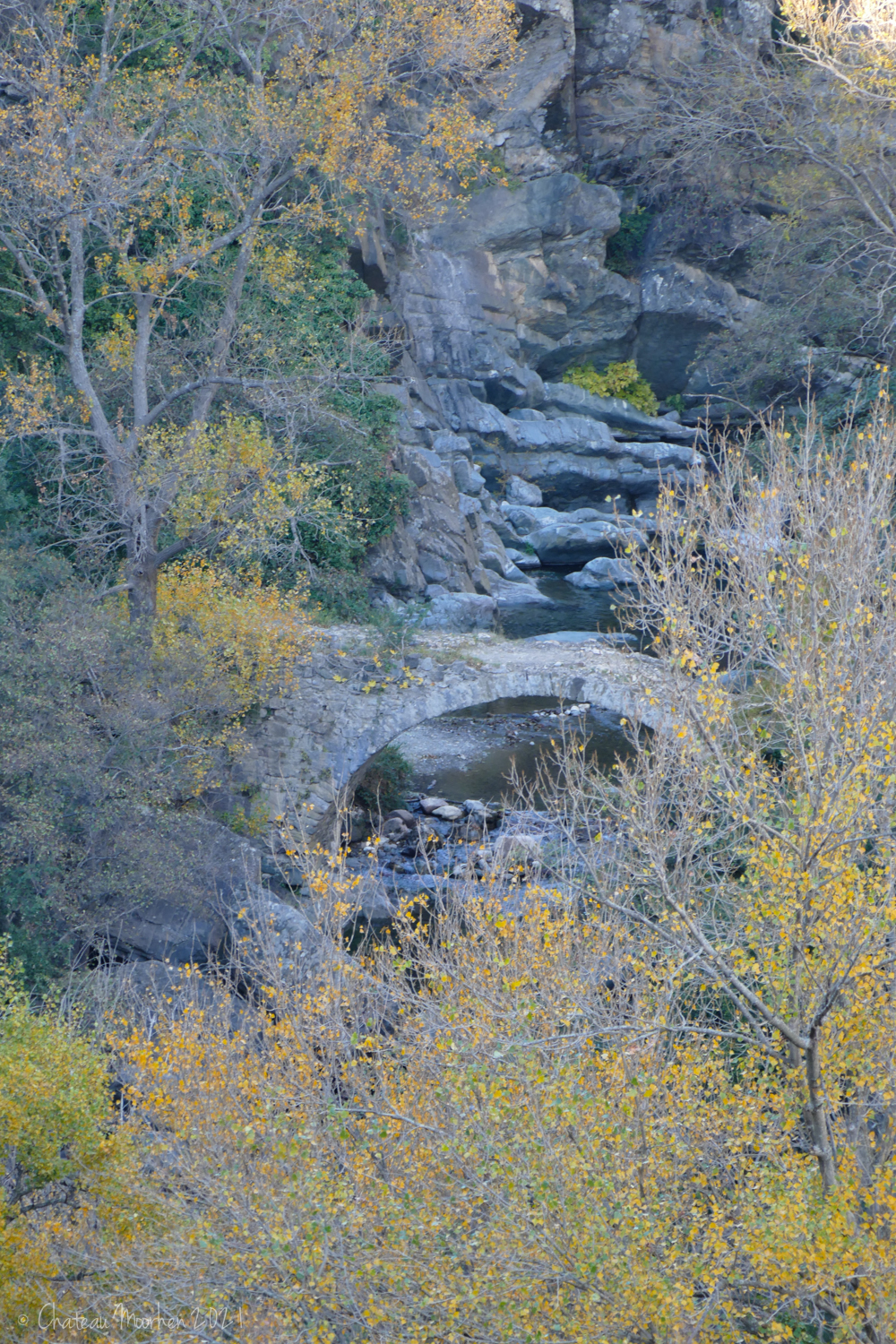
This next photo is very zoomed in, looking towards the left down the above gorge, where you can see the old Roman Bridge. Funnily enough, there is some water here (the Briant river), yet further along where we went down to the river bed, it was dry.
There's some interesting bird life around here, and in winter it is well known as a place where Wallcreepers can be found. There are also Rock Sparrows, which perch up on the roofs of the buildings, and Crag Martins, which swoop around over the village and perch on the sides of the bridge. Whilst we were scanning with our binocs Keith suddenly spotted a Wallcreeper! This is only the second one we have ever seen, but unfortunately it too was the other side of a gorge, so not exactly easy to watch or photograph! We didn't have the spotting scope with us as we planned on a nice walk around, and K didn't bring his new long lens (on his new Canon dslr), and I had my Lumix bridge as I thought I was going to be taking photos of scenery, not distant birds!
So, can you spot the Wallcreeper in the following zoomed in to the max 400mm optical lens of my Lumix? 😀😂😀
I can just see it, but then I know where it was. 😀 The following photo is zoomed in to max digitally, which is of course dreadful, but it's a record shot. If you look in the middle of the image on the vertical grey patch, the bird is a grey bird looking upwards with a black stripe down its side (along the wing edge). If you should ever get to see them closer up, or preferably in flight, they have amazing red feathers under their wings, but like this you can't see the colour. One good thing about Wallcreepers is that they flit about a lot on the rock face, so the movement helps to find them.
This tower is called La Candela and is the remains of an ancient chateau which was reconstructed in the 13th century. So, a new building then. 😀
The walking tour which I'm taking you on goes to the left of the village around the ramparts and down into the dry river bed, then we come back up into the village around where the viaduct bridge is.
There's been a new footpath under construction the last two years but it is finally finished, so we enjoyed seeing this side of the town from a different angle. The first thing which stood out was this building, sitting on a very interesting 'foundation'! 😀 I think from the street side it just looks like any other old stone village house, but I wouldn't fancy going in it! They have cut back the vines but the upstairs window looks like it needs a bit of work doing to it. Or maybe that IS the work? 😂
I would also find this pillar a bit worrying, as I assume it's there to help hold up the buildings....😱
Looking back to the start of the new footpath, the house with the dodgy foundations and the new planting, which I like very much (very similar to my new Pollinator Bed). I love the wild grass here - at least it looks wild to me, rather than something which has been planted, unless they have specifically sown it for the rippling effect of the grass flowers.
I don't have a wide enough angle lens to fit it all in, so here's the gorge again above the river Briant (also known as Brian, but pronounced the same in French anyway).
Now we turn around and look forward again. This is a replica of one of the four Trebuchets which attacked the village; this one in particular called la Malvoisine, was aiming for the town well. A trebuchet is a giant catapault and was a medieval weapon. There is a huge amount of history to Minerve, much relating to the Cathars who were a weirdo offshoot of Catholicism, persecuted by the Catholic Church during what became known as the Albigensian Crusade. Cathars are the people who built all the defensive castles perched up on rocks dotted about through much of our department, Aude. In a nutshell, Simon de Montfort beseiged Minerve back in 1210 and when he eventually destroyed the town's well, they had no choice but to surrender. Negotiations ensued to save the townsfolk, but the 140 Cathars refused to renounce their faith so were burned at the stake in the village square. Nice one, Simon.
This was the first time we have seen the riverbeds completely dry, as we have visited before in February and in December, I think another time too, and each time there has been water running into the tunnel. Of course, we had to go down and walk on the riverbed to experience it!
I know this is a bit of a small image of a butterfly, but for the record, it was so lovely to see some butterflies again! This Clouded Yellow stopped near me very briefly, and we also saw some Whites, a few Red Admirals and a Small Copper. Down in the gorge and in the village there were still plenty of flowers, so I imagine it is very mild and sheltered here during winter.
The only thing that disappointed me about the day is that I was hoping to get lots of photos of lovely autumn leaves, only to realise as we got closer that the green hills that we were heading towards were in fact covered in evergreen flora! It's all garrigue type of vegetation around here, with just a few deciduous trees here and there, particularly growing down at river level.
You can't drive into the village but the walk from the parking is not far and is very scenic so expect it to take twice as long as you would have thought!
May I suggest that you view all these photos larger by clicking on them as they don't show as sharply like this as when you see them full size.
Minerve from the car park, where we had lunch first.
Minerve is perched up on a cliff above two rivers which meet here, the Briant and the Cesse. Over the millennia they have carved their way through the rocks leaving some amazing shapes where the rock has been worn away, and on one side of the village, the Cesse river disappears into a cave/tunnel called the 'Pont Naturel' ('Natural Bridge'); it comes out into the open for a short distance before disappearing into another shorter tunnel.
This next photo is very zoomed in, looking towards the left down the above gorge, where you can see the old Roman Bridge. Funnily enough, there is some water here (the Briant river), yet further along where we went down to the river bed, it was dry.
There's some interesting bird life around here, and in winter it is well known as a place where Wallcreepers can be found. There are also Rock Sparrows, which perch up on the roofs of the buildings, and Crag Martins, which swoop around over the village and perch on the sides of the bridge. Whilst we were scanning with our binocs Keith suddenly spotted a Wallcreeper! This is only the second one we have ever seen, but unfortunately it too was the other side of a gorge, so not exactly easy to watch or photograph! We didn't have the spotting scope with us as we planned on a nice walk around, and K didn't bring his new long lens (on his new Canon dslr), and I had my Lumix bridge as I thought I was going to be taking photos of scenery, not distant birds!
So, can you spot the Wallcreeper in the following zoomed in to the max 400mm optical lens of my Lumix? 😀😂😀
I can just see it, but then I know where it was. 😀 The following photo is zoomed in to max digitally, which is of course dreadful, but it's a record shot. If you look in the middle of the image on the vertical grey patch, the bird is a grey bird looking upwards with a black stripe down its side (along the wing edge). If you should ever get to see them closer up, or preferably in flight, they have amazing red feathers under their wings, but like this you can't see the colour. One good thing about Wallcreepers is that they flit about a lot on the rock face, so the movement helps to find them.
This tower is called La Candela and is the remains of an ancient chateau which was reconstructed in the 13th century. So, a new building then. 😀
The walking tour which I'm taking you on goes to the left of the village around the ramparts and down into the dry river bed, then we come back up into the village around where the viaduct bridge is.
There's been a new footpath under construction the last two years but it is finally finished, so we enjoyed seeing this side of the town from a different angle. The first thing which stood out was this building, sitting on a very interesting 'foundation'! 😀 I think from the street side it just looks like any other old stone village house, but I wouldn't fancy going in it! They have cut back the vines but the upstairs window looks like it needs a bit of work doing to it. Or maybe that IS the work? 😂
I would also find this pillar a bit worrying, as I assume it's there to help hold up the buildings....😱
Looking back to the start of the new footpath, the house with the dodgy foundations and the new planting, which I like very much (very similar to my new Pollinator Bed). I love the wild grass here - at least it looks wild to me, rather than something which has been planted, unless they have specifically sown it for the rippling effect of the grass flowers.
I don't have a wide enough angle lens to fit it all in, so here's the gorge again above the river Briant (also known as Brian, but pronounced the same in French anyway).
Now we turn around and look forward again. This is a replica of one of the four Trebuchets which attacked the village; this one in particular called la Malvoisine, was aiming for the town well. A trebuchet is a giant catapault and was a medieval weapon. There is a huge amount of history to Minerve, much relating to the Cathars who were a weirdo offshoot of Catholicism, persecuted by the Catholic Church during what became known as the Albigensian Crusade. Cathars are the people who built all the defensive castles perched up on rocks dotted about through much of our department, Aude. In a nutshell, Simon de Montfort beseiged Minerve back in 1210 and when he eventually destroyed the town's well, they had no choice but to surrender. Negotiations ensued to save the townsfolk, but the 140 Cathars refused to renounce their faith so were burned at the stake in the village square. Nice one, Simon.
This was the first time we have seen the riverbeds completely dry, as we have visited before in February and in December, I think another time too, and each time there has been water running into the tunnel. Of course, we had to go down and walk on the riverbed to experience it!
I know this is a bit of a small image of a butterfly, but for the record, it was so lovely to see some butterflies again! This Clouded Yellow stopped near me very briefly, and we also saw some Whites, a few Red Admirals and a Small Copper. Down in the gorge and in the village there were still plenty of flowers, so I imagine it is very mild and sheltered here during winter.
I will continue in Part 2 as I have a lot more photos!
P.S. We had a sprinkling of snow yesterday morning!!!
Part 2 is here.
Monday, 26 July 2021
Etang de Bagnas and Lesser Kestrels nesting at St Pons de Mauchiens
We are going back to the end of June now for the last outing with Birding Languedoc of their Spring 2021 season. We felt it went out with a bang! We have really enjoyed our trips with them, both last year and this, and have seen innumerable lifers (not just lifer birds!), other wildlife galore and wildflowers to die for. We feel very lucky indeed to have moved here coinciding with them starting to run day trips for the people living here (as well as their more normal birding holidays). For them, with the pandemic arriving, it has been a godsend as it has helped them with a bit of, I'm sure, much needed income!
We started in the morning with a private visit to Etang de Bagnas, a reserve which normally has no public access, but allows accompanied visits. The lake entrance is locked off with a gate, so the public can only stop at the parking and view the lake from this one place. The reserve is one and a half hours from home using the motorway, near the resort town of Agde and close to the Etang de Thau, which runs from Marseillan at one end to the port of Sete at the other.
First we were given a short talk on the history of the reserve by our lovely guide, who I think was enjoying practising her rusty English, with some French thrown in for good measure, which most of us understood. This reserve is fairly surrounded by built up areas and campsites between the reserve and the beach (grey areas on above map), so thankfully this important wetland (dark green and blue areas on map) has not been able to be developed on. We then set off to the lake and walked along one side of it with stops along the way to see what we could see.
What at first seemed like only dozens of coots in fact turned out to be huge numbers of bird life. I know nothing about terns (apart from recognising that a bird is a tern 😀) but in fact there were five different species here! I think I saw three of them; they were moving around so fast it was hard to know which was which, especially with the other birds in the sky! We also had not only Common Swifts but Pallid Swifts swooping about overhead. We saw Glossy Ibis flying overhead, and a number of Purple Herons flew past us which I was really chuffed about as I've only ever seen a few of them, many years ago.
There were Mute Swans (Cygnus olor) and cygnets and a female Pochard (Aythya ferina) with five ducklings, which were so cute to watch! (also in the photo above)
On an island which has a heronry there was a mix of Grey Heron, Great White and Little Egrets and also a juvenile Cattle Egret (on the left of the photo with a fluffy chestnut hairdo!) and a flamboyance of Flamingos (yes really! It's the collective noun which I've only just learned) standing in the water at the edge of it.
Every now and again a Purple Gallinule/Purple Swamphen would appear at the edge of the reeds, which was exciting to see (even though we have seen dozens of them at one place in Spain, and a lot closer up). Well, it was a first for us in France. Even better, a juvenile appeared behind the parent at one point!
I noticed a small blue damselfly so managed to get a few pictures which actually turned out a lot better than I thought they were going to, as my camera was refusing to focus on something so small (it drives me nuts when the SX50 does that). Once home though, I discovered it was a species I had never seen before, the Small Red-eyed Damselfly (Erythromma viridulum)!
Someone else spotted an amazing caterpillar, another lifer for me! This was a Spurge Hawkmoth (Hyles euphorbiae) caterpillar, and although it was already huge, I think it had one more moult to go as the pictures online show it has much more bright red colouring. Here it is eating the stem of what looks like a drying out/dying Euphorbia (commonly called Spurge).
We then went on to the Parc Departementale de Bessilles for our picnic lunch and had a walk around. Our birding guide Karline, who is amazing at spotting Ocellated Lizards, spotted this juvenile peeking out of hole in a dead tree!
After lunch we headed to St Pons de Mauchiens where there is a reintroduced colony of Lesser Kestrels (Falco naumanni) nesting in the roof tiles of the village buildings. This is one of the old villages built on a small hill with a church at the top,
Credit: Fagairolles 34, CC BY-SA 4.0 <https://creativecommons.org/licenses/by-sa/4.0>, via Wikimedia Commons
From our arrival at the car park to our walk just to the lower town we were already seeing lots of Lesser Kestrels! Luckily for us, they seemed to enjoy perching on gutters and TV aerials with their prey, just sitting around, before they were off to feed their babies. These next photos were taken of a male with a butterfly chrysalis in the lower part of the town.
The most obvious difference between the Lesser Kestrel and the Common Kestrel is the lack of spots/markings on the back of the male Lesser, plus he has grey patches on his wings. Females and juveniles are quite similar, though to help with ID, the two species make different sounds and the Lesser is smaller than the Common.
There was also a male Rock Sparrow (Petronia petronia) on one of the roofs.
We then walked through the village up towards the church at the top of the hill.
Credit: Keith Allen
We came to a little park area where we could look out over the roofs and the magnificent views beyond, and there was an orientation board naming all the mountains, hills and villages that we could see from there. The Lesser Kestrels were certainly giving us a wonderful display of flying, and posing with their prey. Then suddenly they would disappear under a roof tile to their nests. I did wonder how on earth they could fit under there and just how much space there would be for the nest and growing babies, but there obviously is! Karline, our birding guide, said that if you are there a few weeks later the youngsters come out from the nests and run about on the roofs before they start to fly! We will have to come back and see that next year.
Male with a cicada:
Another male with unknown grub. We also saw one with a mouse, which it started to eat on the wing!
Female with insect - you can see how easy it is to tell the males from the females.
Credit: Keith Allen
This is where we were viewing the birds from:
The fabulous view beyond the roofs - here we are looking inland to the Haut Languedoc range of mountains:
The Lesser Kestrels were disappearing into their nests under the edge of these roof tiles!
Way off in the distance a Short-toed Snake Eagle (Circaetus gallicus) was spotted - with a snake! Keith managed to get a very distant shot of it, and Philippa from Birding Languedoc was just watching it through her scope when the Eagle "sucked the snake up like it was spaghetti"!! 😄
Credit: Keith Allen
One final photo - behind where we were standing watching the birds was this amazing wall - build around huge rocks. If you look closely (click on photo) you can see a couple of tiny windows, one of which has been filled in, so I don't know what is behind, possibly a basement area of the church. It's been patched up and mortared over the years/centuries and is so interesting when you just look at the structure of the building. Shame about the crowd control barrier in the scene but I imagine that's to stop people parking there.
A full report of this trip with photos is available to read on the Birding Languedoc website, along with a list of species seen (and heard) during the day here. Amazingly it totalled 45 species, not that I saw them all, or some were just a glimpse!
We started in the morning with a private visit to Etang de Bagnas, a reserve which normally has no public access, but allows accompanied visits. The lake entrance is locked off with a gate, so the public can only stop at the parking and view the lake from this one place. The reserve is one and a half hours from home using the motorway, near the resort town of Agde and close to the Etang de Thau, which runs from Marseillan at one end to the port of Sete at the other.
First we were given a short talk on the history of the reserve by our lovely guide, who I think was enjoying practising her rusty English, with some French thrown in for good measure, which most of us understood. This reserve is fairly surrounded by built up areas and campsites between the reserve and the beach (grey areas on above map), so thankfully this important wetland (dark green and blue areas on map) has not been able to be developed on. We then set off to the lake and walked along one side of it with stops along the way to see what we could see.
What at first seemed like only dozens of coots in fact turned out to be huge numbers of bird life. I know nothing about terns (apart from recognising that a bird is a tern 😀) but in fact there were five different species here! I think I saw three of them; they were moving around so fast it was hard to know which was which, especially with the other birds in the sky! We also had not only Common Swifts but Pallid Swifts swooping about overhead. We saw Glossy Ibis flying overhead, and a number of Purple Herons flew past us which I was really chuffed about as I've only ever seen a few of them, many years ago.
There were Mute Swans (Cygnus olor) and cygnets and a female Pochard (Aythya ferina) with five ducklings, which were so cute to watch! (also in the photo above)
On an island which has a heronry there was a mix of Grey Heron, Great White and Little Egrets and also a juvenile Cattle Egret (on the left of the photo with a fluffy chestnut hairdo!) and a flamboyance of Flamingos (yes really! It's the collective noun which I've only just learned) standing in the water at the edge of it.
Every now and again a Purple Gallinule/Purple Swamphen would appear at the edge of the reeds, which was exciting to see (even though we have seen dozens of them at one place in Spain, and a lot closer up). Well, it was a first for us in France. Even better, a juvenile appeared behind the parent at one point!
I noticed a small blue damselfly so managed to get a few pictures which actually turned out a lot better than I thought they were going to, as my camera was refusing to focus on something so small (it drives me nuts when the SX50 does that). Once home though, I discovered it was a species I had never seen before, the Small Red-eyed Damselfly (Erythromma viridulum)!
Someone else spotted an amazing caterpillar, another lifer for me! This was a Spurge Hawkmoth (Hyles euphorbiae) caterpillar, and although it was already huge, I think it had one more moult to go as the pictures online show it has much more bright red colouring. Here it is eating the stem of what looks like a drying out/dying Euphorbia (commonly called Spurge).
We then went on to the Parc Departementale de Bessilles for our picnic lunch and had a walk around. Our birding guide Karline, who is amazing at spotting Ocellated Lizards, spotted this juvenile peeking out of hole in a dead tree!
After lunch we headed to St Pons de Mauchiens where there is a reintroduced colony of Lesser Kestrels (Falco naumanni) nesting in the roof tiles of the village buildings. This is one of the old villages built on a small hill with a church at the top,
Credit: Fagairolles 34, CC BY-SA 4.0 <https://creativecommons.org/licenses/by-sa/4.0>, via Wikimedia Commons
From our arrival at the car park to our walk just to the lower town we were already seeing lots of Lesser Kestrels! Luckily for us, they seemed to enjoy perching on gutters and TV aerials with their prey, just sitting around, before they were off to feed their babies. These next photos were taken of a male with a butterfly chrysalis in the lower part of the town.
The most obvious difference between the Lesser Kestrel and the Common Kestrel is the lack of spots/markings on the back of the male Lesser, plus he has grey patches on his wings. Females and juveniles are quite similar, though to help with ID, the two species make different sounds and the Lesser is smaller than the Common.
There was also a male Rock Sparrow (Petronia petronia) on one of the roofs.
We then walked through the village up towards the church at the top of the hill.
Credit: Keith Allen
We came to a little park area where we could look out over the roofs and the magnificent views beyond, and there was an orientation board naming all the mountains, hills and villages that we could see from there. The Lesser Kestrels were certainly giving us a wonderful display of flying, and posing with their prey. Then suddenly they would disappear under a roof tile to their nests. I did wonder how on earth they could fit under there and just how much space there would be for the nest and growing babies, but there obviously is! Karline, our birding guide, said that if you are there a few weeks later the youngsters come out from the nests and run about on the roofs before they start to fly! We will have to come back and see that next year.
Male with a cicada:
Another male with unknown grub. We also saw one with a mouse, which it started to eat on the wing!
Female with insect - you can see how easy it is to tell the males from the females.
Credit: Keith Allen
This is where we were viewing the birds from:
The fabulous view beyond the roofs - here we are looking inland to the Haut Languedoc range of mountains:
The Lesser Kestrels were disappearing into their nests under the edge of these roof tiles!
Way off in the distance a Short-toed Snake Eagle (Circaetus gallicus) was spotted - with a snake! Keith managed to get a very distant shot of it, and Philippa from Birding Languedoc was just watching it through her scope when the Eagle "sucked the snake up like it was spaghetti"!! 😄
Credit: Keith Allen
One final photo - behind where we were standing watching the birds was this amazing wall - build around huge rocks. If you look closely (click on photo) you can see a couple of tiny windows, one of which has been filled in, so I don't know what is behind, possibly a basement area of the church. It's been patched up and mortared over the years/centuries and is so interesting when you just look at the structure of the building. Shame about the crowd control barrier in the scene but I imagine that's to stop people parking there.
A full report of this trip with photos is available to read on the Birding Languedoc website, along with a list of species seen (and heard) during the day here. Amazingly it totalled 45 species, not that I saw them all, or some were just a glimpse!
Subscribe to:
Posts (Atom)