I'm putting both these sites on one post so it's a bit photo heavy!
The first is just south of the city of Valencia, near a lagoon known as L'Albufera. The site, called Racó de l'Olla, is about 50 hectares in size but the area where visitors can go is quite small, however there is a useful visitor centre and the reserve was full of birds when we visited. There is an observation tower above the visitor centre, where I am taking a photo in the image below. There are a number of small lakes, some with islands or scrapes for birds to nest or just rest on. Also very useful were lots of info panels telling you the names of the most common shrubs and trees, most of which of course I didn't know from adam.
Photo credit: Keith Allen
Looking towards the main lagoon.
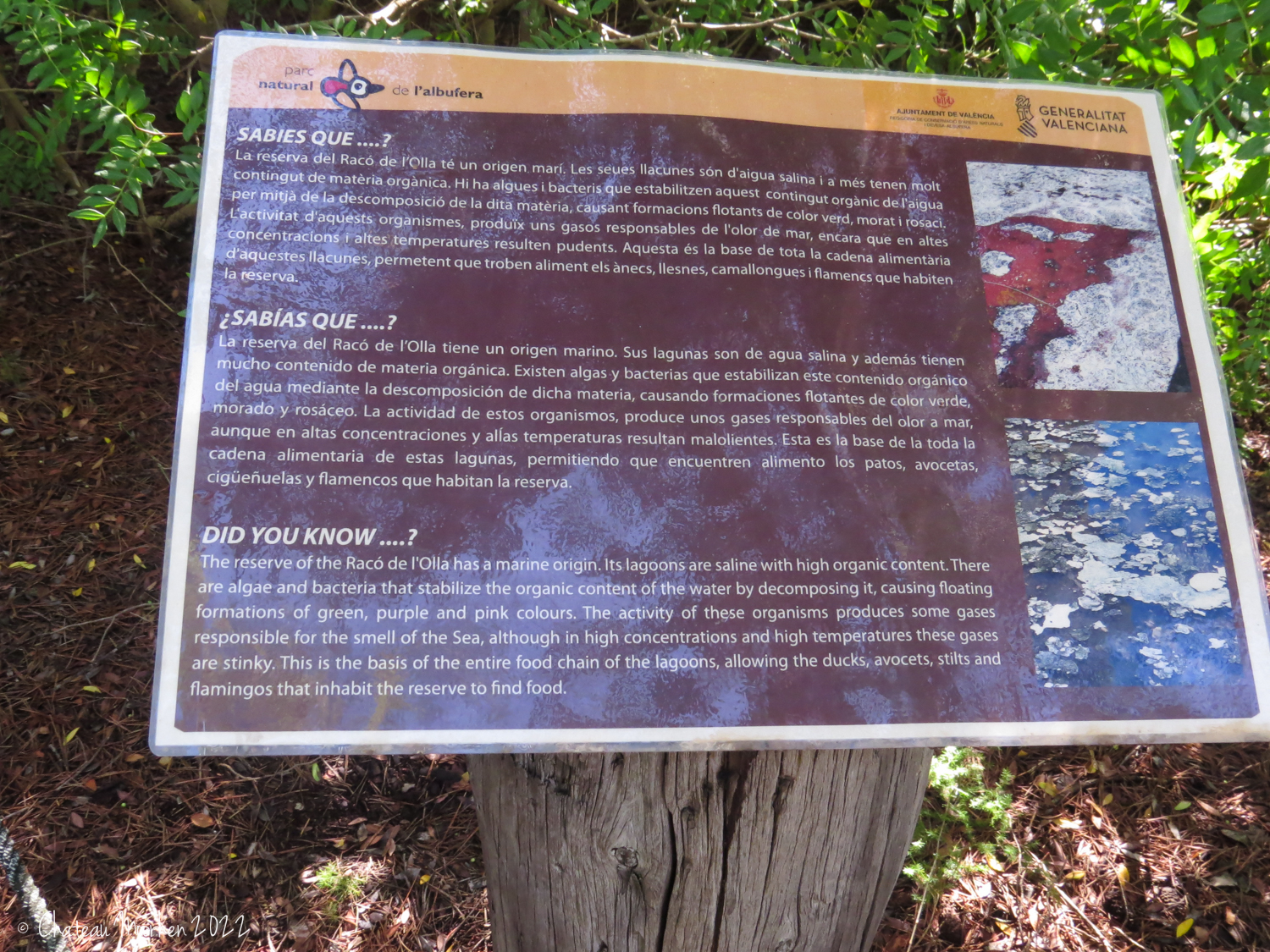
I was looking at the water in one of the smaller ponds and thinking, yuk, that's really murky around the edges. I then looked down and read the info board in front of me, and it all became clear. Read it - it explains all about the ecosystem of the lagoons and ponds. Click to view larger if necessary.
You might remember me mentioning the Kingfisher (Alcedo atthis) which perched near me when I was in a hide - here are a few more shots of it. I can't get the colour any better than this in Lightroom, as it was very backlit so I had to really overexpose my images, and we were looking through glass. I'm still happy with the shots though. 😀
A bit later it then landed on the other (sunny) side of the hide, and I just managed a few quick shots not even very zoomed in, before it flew off. Such is life! It proves how important it is to take photos AS you zoom in, not just wait until you have zoomed in fully. You may well miss many shots that way!
This is a female Red-veined Darter (Sympetrum fonscolombii). I found a new site which is very useful, called Odo-nutters, which has good info about ID, always necessary when immature and female dragonflies can look so different to mature male ones!
Of course there were Flamingos!
Photo credit: Keith Allen
The waders in this shot are mostly Ruffs, though there are also Black Winged Stilts, Mallards and Little Egrets in the background.
Photo credit: Keith Allen
A closer up view of the Ruffs below, with a couple of Redshanks (the birds with red legs). In another shot there were some Little Stints, and a small Plover, not sure if one of the Ringed Plovers or a Kentish Plover, but it isn't worth sharing as they were quite distant.
Photo credit: Keith Allen
Moving on to the area across the road from our campsite, which was only a few kms from the bird reserve. Here it is very interesting as all this area had started to be developed with the tourist boom in the 1960s, then it was decided by the powers that be that it would be returned to the wild. There were info boards explaining this with photos of bulldozers getting rid of tons of concrete, and then the double dune system (see photo further down) was restored and - I'm not sure if it was replanted or left to nature to do its thing - looks very mature now.
Taken from this pdf which explains all about this area, known as Devesa:
"The process of urban development almost destroyed the Devesa as a natural space, but at the end of the 1970s the process of development was stopped and in 1980 the Valencia City Council created the Devesa-Albufera Technical Office which was responsible for the management, conservation and recovery of the space."
Lovely wide walking/cycling paths were laid through the dune slack area (the flat area between the dunes) leading to the beach, the bird reserve and a small lagoon near the sea.
This is the dune system. The sea is on the left and the Albufera lagoon on the right, with the lagoon side dune being more soil than sand, whereas the beach side one was more sand, thus different species of plants would grow in each habitat, and different creatures would inhabit each area. The whole area here is a narrow spit between the sea and the lagoon.
Me near the small lagoon, which you can just see.
Photo credit: Keith Allen
In this picture you can just see the city of Valencia in the background.
Photo credit: Keith Allen
Now we move much further south to the bottom end of the Valencian Comunidad near the border with Murcia, to a reserve called El Hondo (also known as El Fondo!). There is only a small area close to the visitor centre itself, although there are several other long paths you can follow, but trying to make sense of the maps it seems so you have to return the same way. There is another area which is closed off though I understand you can contact them to ask for permission to enter, but we didn't have time to do that.
We saw two lifers - both were species that we had read about before coming, which was why we came here! At the visitor centre there was a small pond which was visible through a huge glass window. Here were the Marbled Ducks (Marmaronetta angustirostris) that we had heard about, and also quite a few Purple Gallinules, oblivious to us watching them.
Photo credit: Keith Allen
Photo credit: Keith Allen
I managed this shot of a Purple Gallinule (Porphyrio porphyrio) through the glass.
Further along the walk were dozens of coots and the second target species was a Red-knobbed Coot (Fulica cristata) - have you ever heard of them? Keith hadn't, but I think I have seen them in my bird book. To ID them we had to scan through all the dozens of coots, not something I've ever done before as coots are normally so common one doesn't really bother much about them! 😀 We found several of the Red-knobbed ones eventually. They really do look rather strange with the red appendage on the top of their heads!
Photo credit: Keith Allen
Photo credit: Keith Allen
The icing on the cake at this site was seeing an African Monarch (Danaus chrysippus) again! I saw one by a beach in the Ebro Delta some years back which really confused me as I'd never heard of this species before. I was talking to our bird expert from Birding Languedoc recently and she said she had seen one once on the coast in the Languedoc, so they do get as far north as France occasionally.
Phew, did you manage to get to the end? Bravo to you! I put the different birding areas together as I haven't blogged for a while, so whilst I'm in the mood I'd better get it all done! I've also been busy wielding my paintbrush on walls again, although I have only done 1/4 of the room, because we wanted to get replace a hideous 1970s G-Plan corner cabinet that we inherited with the house. In its place is now a modern Ikea cubby unit with space for photos/ornaments and plenty of drawers and cupboards for all our photography gear. It's nice having everything properly organised for the first time!
My brother is coming soon, so I've got lots of things to do, like decorate, bake and housework, but I'll make sure I find time to come back to blogland to say something seasonal and visit your blogs. 😀
About halfway through our trip, we stayed three nights in L’Albir, which is at the other end of the bay from busier Altea. Altea however has a very pretty old town and I have lots of photos from that visit, which I’ll sort out when home. So for now, I’ll take you along this 5km there and back walk to the lighthouse of Albir, which looks back over the whole bay area.
The path was fantastic, nice flat even concrete so you can walk along admiring the scenery without having to watch for rocks or roots which invariably trip me if I’m not careful on most walks! The downside was that it was part cloudy and very hazy the morning that we walked here. It seemed very humid in L’Albir, so we wanted to get our exercise out of the way in the cooler morning! It did clear a bit along the way, so we were hugging the shady side on the way back.
Altea zoomed in above, and K at the beginning of the walk with L’Albir in the background below.
Below, Mediterranean Heather (pink flowers) and Rosemary flowering everywhere on the rocky garrigue.
(A side note: I don’t know what’s going on here but since all the insects in my first post there have been very few, and south of Valencia I have barely seen a bee or hoverfly on all these flowers (between the native plants and the foreign species in bloom in people's gardens/campsites) - only a few wasps, flies and mossies. Crickets have been making their summery noise at night when we pass wasteland on the way to a restaurant but apart from that, and a few Red Admirals and White butterflies, virtually nothing! OK, it’s late October, but it’s about 28C during the day and mild at night. It’s just very weird - and disappointing!)
You can just see the lighthouse at the top middle of the photo below. If you click to view larger, it will be clearer.
There used to be an ochre mine here in the 19thC through to early 20thC. Info is given in English in the following photo on the info board (click to view larger if you can’t read it).
There was a good photographic display about the families who worked at the lighthouse, which was difficult to access back in the olden days. Two families would live in this building, with the two lighthouse keepers.
You can see the path running left to right through the middle section of the photo.
Lavandula dentata, which PlantNet calls French Lavender; however I always thought that was the Papillon Lavender, which is L. stoechas. I haven’t seen this species of Lavender growing wild before.
We are enjoying our last week and started heading back north today, first stop the Ebro Delta for a couple of nights and some birding around the lagoons and rice paddies. 😄
This desert-like area was just over the border into Murcia, which I read somewhere was the, or one of the, most arid parts of Spain. We had already been driving through fields of different kinds of produce - from most of Valencia’s oranges, rice and olives to orchards of pomegranates and fields of date palms. I’m now feeling inquisitive as to what they might grow in the very south of Spain! Strangely enough, around Valencia there have been many fields of globe artichokes, a crop very common around Roscoff in Brittany. And even stranger indeed, fields galore of cabbages. I’m amazed they would grow through the heat of Spain’s summer, even though of course they are irrigated.
Here however, there was nothing. Nada. Oh ok, a few olives here and there. 😄
All photos are SOOC again, and the sky was hazy, but you can see from the pic of Keith and his bright shirt that the landscape colours really were that pale colour. Those were mostly rocks rather than soil where they are completely devoid of vegetation. I love these weird kind of landscapes!
Looking in the other direction it’s a little greener with an olive grove in the middle of the wild landscape.
I don’t know what this plant is below - it’s a rush-like plant (I’ll PlantNet it when I get home as it’s fascinating) and it’s so amazing to see signs of life even on seemingly half dead things. I’m not sure if these tiny pretty peach flowers are actual flowers, or bracts.
Other life? I saw my first real, through binoculars, Dartford Warbler! 💕 We think we’ve seen them before when we didn’t have binocs, because of the way they hold their long tails, like a wren. Even this time the bird was backlit so couldn’t see all the details and colours, but I’ll take that as a tick!
Here are a couple of pics of me at Morella; they were on K’s phone so I didn’t have them at the time of doing the last post. The burger is a very weird deconstructed one at a quite posh restaurant, delicious, but give me a regular burger any day! 😄
I’m sorry I haven’t visited any of your blogs, my evenings are busy downloading photos and checking out places to park and that kind of thing for the next day and more Facebooking than usual due to posting a few photos there. Be back soon!
Hi guys, day 9, I think, of our Spanish adventure. Thanks so much to those of you who commented on my last post - sorry, have not as yet got round to stealing K’s laptop in order to reply! Last night I had no internet connection on my iPad and K had a very occasional weak one through his laptop (the phone had lost any signal on our second day at that campsite, very strange as it was fine the day before). So I spent my time playing around with some of my photos on Snapseed.
I’m going to leave the bird posts until we come back, as most will be better after an edit on a big screen, but I do want to share this one. We were at a small reserve/lagoon yesterday just south of Valencia, in a hide with a lot of wader and duck activity, when a Kingfisher landed on a tree next to me. No one else in the hide noticed so I snapped away happily, but I was rather disappointed with the results because (1) I was shooting through glass and (2) the bird was very backlit so I had to really underexpose to get any details. But with a Snapseed filter and a bit of extra editing, I have brought up some of the colours. I actually got some more photos of one in the sun, but just as I was zooming in, it flew off!
Do click on the image to view larger as you will probably see many more details than on the smaller photos in amongst the text.
Back to our trip - we spent four nights in Peniscola, which is just south of the Ebro Delta, in the Valencia province. The campsite we had planned to stay at was full! That’s a first for us. They directed us to another site, a bit closer into the town but quite a tight squeeze and not the nicest of pitches, as it had been very wet, and did rain again one night. But we’ve had lovely weather every day.
The day we had a wander around the town, we had lunch opposite the castle, which appeared to close whilst we were sitting there, so we never visited, as we had other things planned for the other days. To be honest, we were so stuffed after a fantastic tapas lunch with the freshest fish and squid I’ve ever had fried like that, that we were both rather pleased we did not have to climb up and down stairs to visit the castle!
The old town up on the hill is lovely, very Greek with white buildings and lots of Greek blue shutters and windows etc. Here’s me in front of one of the gates into the old town.
Many of the balconies have pretty tiles on the underside - what a brilliant idea!
The church next to the castle.
A part of the castle - we weren’t anywhere where we could get a good shot of the whole of it!
I love the decoration on the buildings - they all have the same size very narrow balconies, only big enough for plants, but some people really go to town and many have these tall narrow cacti on them, or varied cacti on the ground like here!
Keith given a Snapseed filter - he took a shot of me here but I had my eyes closed! 🙄😄
Looking back over the new town from the old town.
One day we visited the small town of Morella, about an hour inland. Again, it has a castle up on the top of a hill with the town below it. This castle was higher up so I never had any plans to walk up to it (I’m saving my energy for walking on the birding days) and K was in complete agreement! It’s also quite difficult if you want to eat out for lunch to then go doing that kind of exercise!
I didn’t get to editing any of these, so they are just SOOC, as they say, Straight Out Of Camera. I also have not given you any historical info, it’s all too much on the iPad so there’s a link to Wikipedia above about this town.
Views from the town over the countryside, and from the town to the castle.
It was really arid here inland, yet so green by the coast!
Birding has been hit and miss with some places abundant with wildlife, and others with very little birdlife, although always there are dragonflies (mostly Red-veined Darters) and I’ve seen a good butterfly, a Long-tailed Blue (Lampides boeticus)!
That’s it for now, off birding again tomorrow then we start our slow journey back, stopping at more coastal places for a mix of old towns and nature. 😄