Continuing on with the butterflies that I saw whilst on holiday last September. These ones were all seen by the Mediterranean sea, both in France and in Spain.
Not a lifer but I don't see these Mallow Skippers (Carcharodus alceae) very often, and I only saw one other skipper whilst away, a Small Skipper up in the mountains; interestingly enough it was pudding close to the Adonis Blues.
10. I'm now not sure that the following two butterflies are the same species or not! It pays to double check before you post those original IDs that you noted. I think the butterfly on the right is a Rock Grayling (Neohipparchia statilinus), but am unsure of the one on the left which was taken in the same location. It doesn't help when the butterflies are very flitty and you don't have very good photos, or they are a tad worn. There were quite a few of these drab brown butterflies flying around the rocky headland next to our camp site at L'Escala. Despite such barren conditions I also saw Wall Brown, Small White and Painted Lady here.

11. Now this one definitely is a lifer and there were lots of them flying around this plant which is something exotic in the pea family. They are Lang's Short-tailed Blues (Leptotes pirithous) and they feed upon plants in the Fabaceae family, amongst others, so that helps with ID. They would not stand still and the shrub was huge, so taking photos was a bit hit and miss; better just to stand back and watch them and enjoy. So long as I can get a few photos for ID purposes then I'm happy. Do you see those two tiny electric blue spots by the little 'tail' though? Aren't they amazing!
I should mention that this and the following species seen on flowers were seen at the beautiful Botanical Garden of Cap Roig at Palafrugell, Costa Brava. If I ever get my A into G I will share photos that I took at this place as it was heavenly.
I'm going to throw a few moths into this post as this next one is just stunning. We also saw a couple mating on a path right beside our camp site, but I prefer this photo of one on a dahlia. It's Zygaena carniolica and it doesn't have a common name in English because presumably it isn't found in the British Isles.
I also saw quite a few of these little moths which were flitting about feeding on Lantana and Heliotrope (?not sure). Not a chance to ID it, unless anyone can help?
Back to the butterflies I include this blurry image as it's the first time I've caught a Clouded Yellow (Colias croceus) in flight and seen the topside of the wings! They always but always have their wings closed when they are perching on something.
I have taken some much closer photos of this butterfly in previous years but even here you can see its stunning green eyes!
Again, not a lifer as I've seen one in my garden, but seeing the regal Queen of Spain Fritillary (Issoria lathonia) in Spain is just icing on the cake.

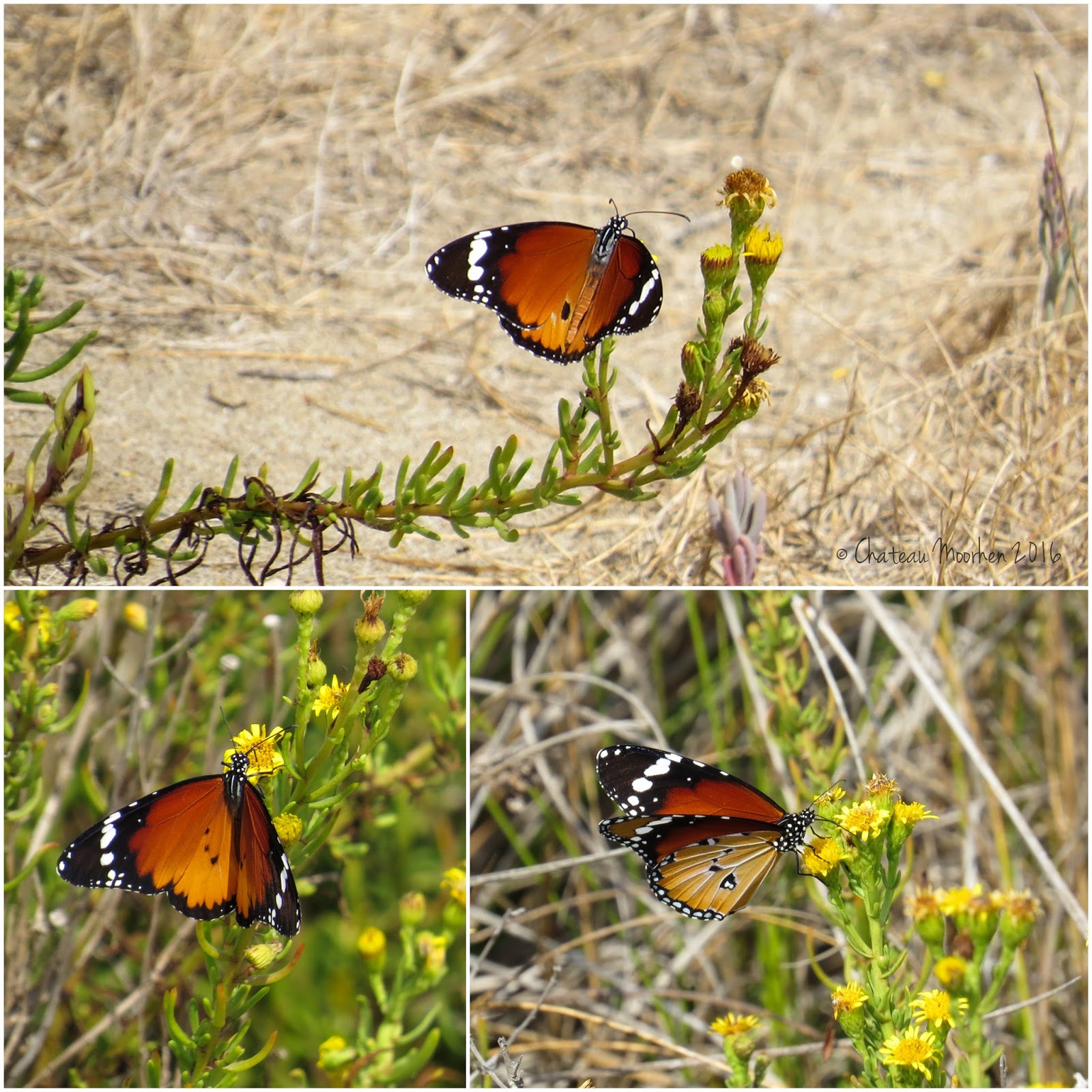
12. I have saved the best till last. This butterfly was seen beside a beach at the far end of the Ebro Delta. Now I knew when I saw it that it was related to the famous Monarch butterfly because of that spotty body, but what it was I had absolutely no idea! I searched my European butterfly book but could only find a picture of the Monarch, as it can be found in Madeira, the Canary Isles and the Azores, where their foodplant, Milkweed, grows. However under the Monarch was a paragraph about the African Monarch .... and a google search showed that it was indeed the butterfly we saw! The African Monarch (or Plain Tiger) (Danaus chrysippus) is an African and Asian species which migrates across the sea to southern Spain. Lucky we saw them where we were as the Ebro Delta, despite being at the far southern tip of Catalonia, is still fairly north-ish. What a fabulous butterfly and not one I was ever expecting to see as I didn't know it existed!


So that makes 12 lifers seen, which is pretty darn good I'd say. We are heading down that way again in May so I hope to see some different species, as there should be plenty of wild flowers in bloom. Can't wait!
I have yet to see a butterfly this year so in the meantime, what better to do than to go through all my butterfly photos and notes from my holiday last September.
I saw a lot of lifers plus ones I've only seen once before, the vast majority being in the mountains or hills where it was green and there were flowers for them to nectar on. In the arid areas - and in September there are a lot - no or few wildflowers meant very few butterflies. Even so, part 2 of this post will feature the butterflies seen once we hit the Mediterranean. These following were in the mountains and foothills of the Ariege and the Pyrenees-Orientales. I'm only numbering the lifers in these posts (lifers being butterflies I've seen for the first time).
1. Number one lifer was at the bird reserve at the Arcachon basin however, a Southern White Admiral (Limenitis reducta), although no photo was possible.
Les Papillons d'Amaranthe, Lesparrou, nr Lavelanet, Ariege
This is a butterfly park but it also has a beautiful flowery garden which is open for you to walk around and spot the native butterflies. Oh, there were tons! I loved it better than the polytunnel with the exotic species.
The butterfly below I've seen once before, in my own garden, but no less exciting. It's a Long Tailed Blue (Lampides boeticus).
2. This is the best photo I could get but I was still able to ID it from my photos - it's a Great Banded Grayling (Brintesia circe).
3. This butterfly was annoyingly flying low in a paddock with some goats so I couldn't get any closer. I think from being able to get a glimpse of the underwings, that this is a Dark Green Fritillary (Argynnis aglaja). Even if it's not, it's still a lifer. And I did see a DG Fritillary later on!
4. More blues, this one being a Provençal Short-tailed Blue (Cupido alcetas).
Provençal Short-tailed Blue again, showing a bit of its upper wings.
5. I'll number this one as a lifer although I don't know what it is, and don't think it's a blue that I've seen before. I need to spend more time IDing but it's those two marks at the base of the front under wing that mean it's definitely not a Common Blue.....
Roadside ditch near the Chateau de Montsegur, Ariege
This ditch was teeming with butterflies as it was full of oregano and pond mint in flower. I could have stayed all day....
One of my blogging friends is going to hate me (you know who you are <grin>); this butterfly isn't a lifer but it's the first time I've seen the beautiful underwings of the Glanville Fritillary (Melitaea cinxia).
6. In the same place, Provence Chalkhill Blue (Polyommatus hispana), or possibly Chalkhill Blue - apparently it's very hard to tell the difference. The Provence one is usually a little lighter, and given where it was seen I'd like to think it was the former.
Eyne Valley, Pyrenees-Orientales
This valley (1600-1700m altitude) is supposed to be very rich in flora and thus insect life - I read somewhere that it has the most species of bumble bees in all of France. In September there were still wild flowers in bloom and whilst we only walked for about an hour an a half uphill we saw many species of butterfly.
7. I'm not 100% sure as I don't have a shot of the underwings, but think this is a Small Pearl-bordered Fritillary (Boloria selene). In any event, it's still a lifer!
Now here is a Dark Green Fritillary (Argynnis aglaja) for sure, and you will see from the blurry movement shot of the underwing how important it is NOT to delete all your blurry shots as they can be very important in helping you with ID!
8. Adonis Blue (Polyommatus bellargus). We were walking beside a small mountain river and in places where the soil was damp there were little clouds of butterflies puddling. This means taking minerals and salts from the soil. Upon reading more on the subject I hadn't realised it is just the males who do this - the minerals in the soil help brighten up their colours and thus make them more attractive to females. It might explain why I saw some Adonis Blues which were darker blue than others. I fell in love with these little butterflies.
9. I also saw several of these butterflies which I managed to partially ID after seeing more of them in another location. This one below is a female Ringlet of some sort, possibly the Autumn Ringlet. I hadn't realised there were so many different kinds of Ringlet and they have some very similar markings!
Mont Louis, Pyrenees-Orientales
The location here was also quite high, about 1500m, beside a mountain river in a forest of pines with open areas of grassland, with a few wild flowers still in bloom.
The same Ringlet as above but this is the male.
Next post to follow shortly. Now I'm itching to see some butterflies, it's been far too long!
Hi everyone! We are back and we've had the most amazing time imaginable! Trying to sort through 1,500 photos has taken some time, and it will be a while before I can write more detailed posts, but for now here's a condensed version of our 25 days away.
We started off visiting Le Teich bird reserve near Arcachon, where they have 20 hides and the walk is about 10km. We did it in 36C and by about 2/3rds of the way around I was ready to be carted off in a stretcher! Birding was a little disappointing; autumn is not as good as spring when the birds are singing so you are much more aware of their presence. We did see plenty of water birds though such as this Lapwing which I've never seen so close before.
Once back at the campsite I knew how to cool off and those new swimming cossies got put to good use!
I saw some great butterflies and managed to total 12 lifers! Most of the butterflies were in the mountains where it was not dried out and there were still wild flowers. We also visited a butterfly farm/park in the Ariège department and as well as enjoying the tropical butterflies in the polytunnel, we spent ages in their outside butterfly garden, which to be honest I enjoyed more. There were tons of butterflies in this garden and I could have spent hours there! I really need some Asters in my garden as they were very popular nectar flowers. Below is a Common Blue - I saw lots of them but as they are rare at home I was happy to see them.
As usual you can never get away from Breton 'cuisine'!
We spent three days in an amazing campsite in the mountains of the Pyrénées-Orientales, at Mont Louis. You couldn't imagine a more peaceful idyllic setting, beside a mountain stream and amongst the pines.
A first for me up in the Eyne valley was seeing multiple butterflies puddling! I've only ever seen single butterflies doing this. These are Adonis Blues along with Small Whites (I think, there are other mountain and southern species of white which are similar).
Then it was off to Spain and the Costa Brava where we had a Moho meetup arranged with Monika, a (virtual) friend who I've known for about nine years, first through the Selfsufficientish forum, and latterly on facebook. We both live in France though Monika lives in the middle. She has the most adorable little dog, Olivia, who I would gladly have stolen if I could have! We spent an enjoyable time together before Monika headed back home and we continued our stay, as we had booked a week at the campsite at L'Escala.
Of course we revisited the wetlands of the Aiguamolls de l'Empordà. This was our third visit and I've already written about our previous visit in 2013 here.
We still found something new in the area and spent an enjoyable afternoon exploring the beautiful botanical gardens of Cap Roig.
The weather wasn't always great though! We had wind and rain too!
The sea wasn't so inviting when the sun wasn't shining and I decided it was too cold to swim in anyway.
After the Costa Brava we headed to the southern part of Catalonia to revisit the Ebro Delta, yet another important wetland area for birds. Here in the photo below is where the first thoughts about motorhomes came into my mind. We were picnicking on the beach in 2013 and there was a solitary van here, and I remember thinking how nice it would be to have your kitchen on board so that you didn't have to secretly steal your lunch from the breakfast buffet, and to have a toilet too! There are very few places to 'go' on the Delta. It's all flat and full of rice paddies or lagoons so no going behind a bush. We had to keep going back to the same cafe to use the facilities! My 2013 post from the Delta is here.
The only downside to having a Moho is the parking - we were unable to find parking space beside the hide where the flamingos were, but a good thing about a Moho is that it is much higher than a car, so you get much better views, and can see over hedges!
Still in the Delta, and very close to our campsite was the organic rice farm of Riet Vell, which has a hide overlooking a lagoon. It was the only place we saw Purple Gallinules in 2013 and lucky for us, we saw a number of them again. You gotta love a Purple Swamphen! They have such huge feet and are so ungainly.
Yet again though, the weather followed us. We got to experience our first thunderstorm inside a tin can. It rained so much that the campsite roads turned into rivers!
Inland from the delta is the mountain range called Els Ports de Tortosa. This was where our car overheated last time and was the start of endless overheating problems which stuffed up our holiday as we had to keep to fairly flat land after that. Mary Moho had no such problems and chugged her way up and down steep zigzag roads effortlessly.
Not all of Spain is scenic - most of where we went was delightful, but these flatlands near to Zaragoza were a bit dull to say the least.
Finally back in the Pyrenees again and we ended doing a couple of trips which we had originally planned for the beginning of the holiday, but it was raining in the mountains then. This next photo was at the Col du Somport which is a border crossing. It was looking quite autumnal up there.
We then headed to the Col du Tourmalet, which is the highest paved road pass in the French Pyrenees at 2,115m altitude, and is often used as a stage in the Tour de France. Consequently it's a good road so we had no problems getting up or down.
Sometimes I manage to get my selfies right!
Just past the Col in the ski village of La Mongie you can take a cable car up to the Pic du Midi observatory perched atop a mountain at 2,877m altitude. Thanks to my bravery riding the Devon Eye I had no problems riding the two cable cars to the top; I loved every minute, including when the car rocked occasionally! The views from the top are superb and in places we were looking down on the clouds. This day was the highlight of my trip. I also have a much better head for heights now when we are driving up and down the mountain roads (or maybe it's because K goes slower than he would in the car), although I still get occasional vertigo.

Our last day in the mountains we did the walk to the Cirque de Gavarnie. There is an amazingly high waterfall at the end (not in this picture). After a much tougher walk than I had imagined, about 5km mostly uphill on a rough track, we made it to the cafe where we ate our picnic lunch. I declined the further walk to the base of the waterfall. I know when I've had enough, and I'm jolly glad we did this walk at the end of our trip when I was considerably fitter than at the beginning. The scenery all around Gavarnie is stunning and we spent our last night in an aire up above the town with mountain views on all four sides - just spectacular.
All too soon it seemed, it was time to say goodbye to the mountains. This though, was the first day that we saw the Pyrenees with no cloud cover somewhere!
And as the Law of Sod would have it, our journey the last but one day was with skies like this all the way, until we neared the coast in Charente Maritime where the clouds from nowhere appeared and enveloped us. Our final day driving home was in pouring rain (and traffic jams), until we got near Rennes, when it stopped. Home was dry - not good for my poor dry garden but great for unloading. Mary Moho is now back in her cupboard and I miss her. We could happily have stayed away longer and that is the plan for next spring.... watch this space!
(Oh and two out of three cats were all over me the moment we got home, Harry, however, took a whole week to forgive me.)