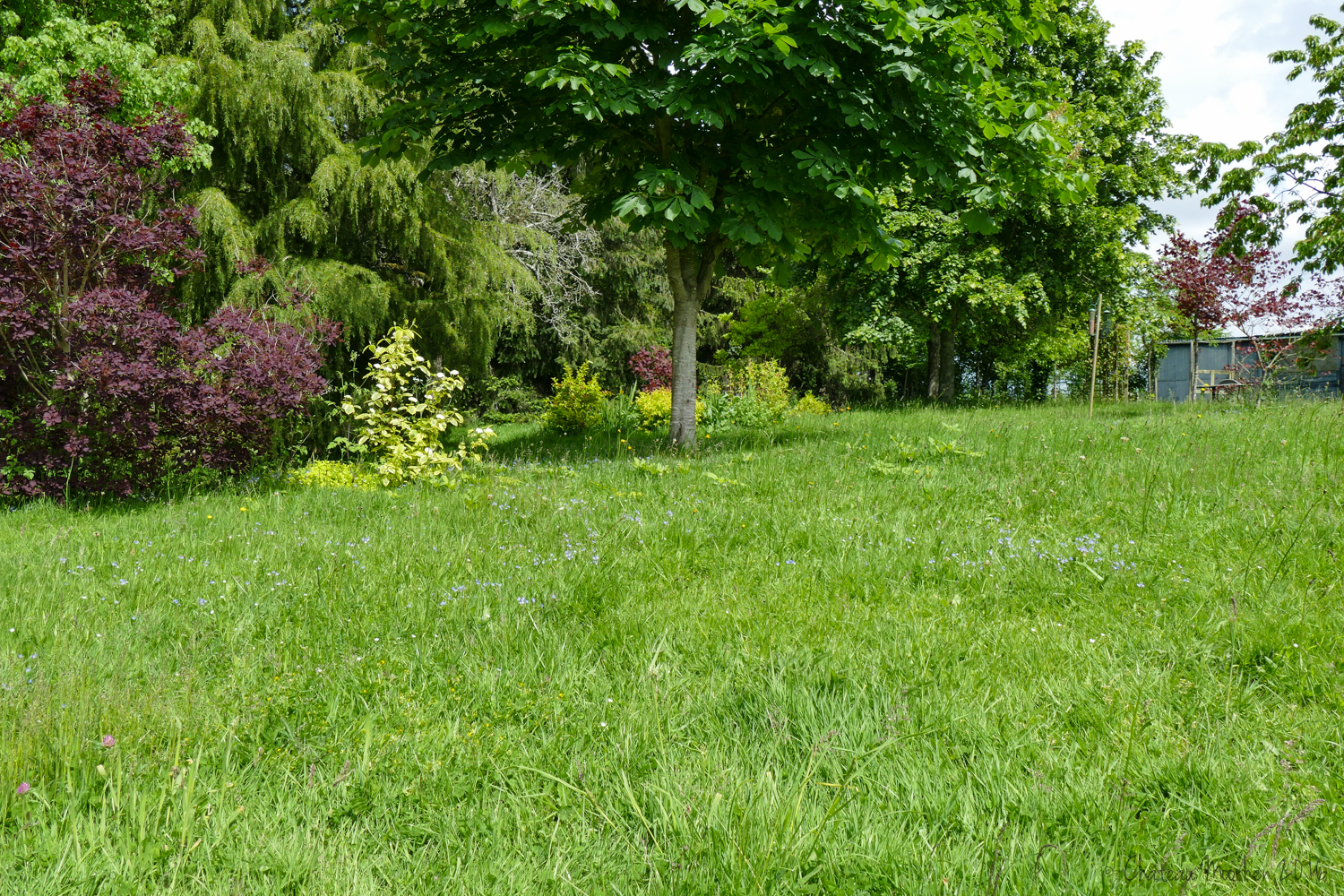
It's been so hot these last four weeks that we haven't been anywhere interesting, not even for a walk. It's a bit sad to not be able to enjoy summer to the full, although we did have a few cooler days recently so I got a chance to do some jobs in the garden. We still have the works going on in the basement so perhaps it's as well that it is hot as we need to be around most of the time to answer queries, make coffee and generally keep an eye on things! I'll post some pictures about that later on when it's all finished.
This first pic was taken on 28 June when the broom was flowering in the grassland across from our house. The tree line behind the broom towards the top is someone's garden, however the trees are spreading/selfseeding into the meadow from their garden too.
I had a wander up the road, pleased to see that there were more wild fennel plants than a few years ago. And then I discovered three Swallowtail (Papilio machaon) caterpillars on one small plant! I often search for them but it's the first time I have ever seen any on wild fennel.
Back in the garden I thought I would have a bash at shooting butterflies in flight. Well I failed miserably at that. Butterflies are way too erratic with their movements! I was using my Lumix bridge camera and maybe I need to try again with my Canon dslr and on an even faster speed. I think I need to set it on the tracking setting, although I never had much luck with that when I tried it before.
Anyway, for the buzzy things which hover or pause, even for a very short time, I did much better with the Lumix than I had imagined. I was really pleased with the camera.
Hummingbird Hawkmoth (Macroglossum stellatarum). As usual, the insect photos are worth clicking on to view larger as there is far more detail in the larger photos.
Beefly - I don't know which species but it could be of the Bombylius genus. I don't think it is Bombylius major which I see in the spring. It would help if I had captured the markings on the wings! I currently see two sizes of beefly at home and this is the larger one.
A Meadow Brown (Maniola jurtina) being photobombed by a tiny bee or wasp!
These large bees have been around in the garden for about the last two weeks. They are the Giant Resin Bee (Megachile sculpturalis) and they are only interested in the Russian Sage (Perovskia) which is a bit odd! These solitary bees use holes in wood to make their nest chambers, but have not discovered my bee hotel - yet.
They have really cool wings which are clear near the body of the bee and dark brown further away.
And this is the largest bee we see, the Violet Carpenter Bee (Xylocopa violacea). This one seems to like my ornamental Sage 'Hot Lips' better than any other plant in the garden.
I managed a shot of this unknown tiny bee on a Cat Mint flower. It has pretty eyes (you'll probably need to click on the photo to view.)
This is a medium sized bee that I was lucky to capture. It must be a leafcutter bee as the following day that hole it was in was filled in, and covered over by small bits of cut leaf, like the other two holes. I have seen a bee in and out of those holes before but it was too fast for me to see it properly, so I am pleased I got this picture! The next day there was a fourth hole filled in so I’m guessing it’s just one egg chamber per hole.


L
Bee activity has slowed down in the bee hotel but there are still a few bees preparing their nest chambers. Some bees like below, have closed the chamber with a strange saliva like substance that looks like bubbly plastic!
With all these pictures, it is much better to click on them to see them much sharper and clearer, not to mention larger.
Below were the first six nests of my yellow and black bee that I mentioned in a previous post - well I have now discovered that it is a Wool Carder Bee (Anthidium species), who don’t use leaves or mud to line their nests, but plant hairs! I don't have any obvious furry leaved plants but there is furry stuff on the spent flowers/seed pods of Perovskia, so it might have come from that. If you look at the two pictures below, you'll see one chamber in preparation, lined with cotton wool like stuff. The other five chambers below have been sealed off; I'm guessing from the colours that four are with some kind of chewed up plant material and the brown one with chewed woody stuff or soil.
This bee eventually made nine nest chambers! She was one busy bee. 😀 I have also seen one again in my herb bed, displaying a rather strange behaviour of buzzing and hovering around a couple of my herbs that are in bloom, occasionally stopping on a flower for a nano second only to buzz off again and continue this strange patrolling. The males of Anthidium manicatum display territorial behaviour, patrolling around their favoured plants and chasing off other pollinators, whilst waiting for females to appear, so it's possible other Anthidium bees do the same. I have no idea how long their nesting season goes on for, so cross fingers there may be more nests in the bee hotel from this species!
There are 11 species of Anthidium in France whilst only A. manicatum in the UK, so I can't be sure which exact species is my bee, though I don't believe they all collect plant hairs. I really don't have the time right now to research this further.
Other solitary bees have chosen the cut pieces of bamboo for their nest chambers, although what has struck me since these chambers were sealed off, is that some of them have been broken into. I know there are parasitic wasps, and also other bees who lay their eggs in the nest chambers of other bees (they are known as Cuckoo Bees), but what has surprised me is that they haven't resealed the chamber. It's not just this one below (top right bamboo), but other different sized holes from other bees have also shown this breaking in....
.... like these tiny holes here - some on the bottom row have been broken into.
So you can see, so much to study and research and keep me occupied! It's all so fascinating and I look forward to seeing a whole year in the life of my bee hotel next year. And I must remember to take my camera out more often and take photos of the bees!
******
Now back to my Wasp Spiders. Below is a young one.
And this is a freshly made web (when the spider wasn't around). The zigzag stabilimentum is quite clear here with a furry mass of web where the spider tends to hang around.
Here we have a very slightly older spider with a male very close to her. Males are very small in comparison to the adult spiders, which you'll see a bit further down. I saw many males this year though I never saw them doing the actual business nor being eaten! Note also in this photo is a moult, known as an exoskeleton. Like many insects, as they grow they shed their outer shell. I tried to take one to keep when the spider wasn't there any more, but it fell apart in my fingers, it was so delicate.
A more mature spider with its wrapped up dinner.
This is part of our ditch between us and the neighbours where many of the spiders could be found, especially around the Oregano which is abundant in the ditch area. This ditch is a passageway for butterflies and other insects, so a good place for spiders to find food.
Underside view of a male spider on its own - I found that after some of the females disappeared that the males would hang around alone for a few days until they presumably went off to find another female.
Now here's a mature female from the under side, with two males. Lucky lady - she had a choice!
You can really see the difference in size now.
This is part of my Nectar Bar and in this patch there were eventually seven mature Wasp Spiders!
The most I counted at one time was 23, but sadly, one by one they disappeared, whether they have been predated or what, I don't know. I'm very disappointed as I think I had some around until September last year, and I have only found one egg sac so far, in the Valerian. Hopefully there will be more in the ditch.
I read that Wasp Spiders can be predated by birds, praying mantises, lizards and wasps, that's not all wasps but probably one of the spider hunting wasps.
We are off in the Moho next week to Provence again, but further to the north of the region in some of the regional parks in the mountains that we haven't visited before, though we'll finish off at our favourite beachside campsite for a few days as usual!
I'll then write about some of our travels during the winter like I did last year. See you in a few weeks! 😀
Hi everyone, I am back from my two week holiday in England. I've had a wonderful time staying with my mum in Somerset and have had some great days out. Lots of photos to share from a few of these trips but first I needed to record my jungle garden before the mower got in there! The photos don't really do the long grass justice, nor the amount of flowerheads from the tall yellow flowered plant - think it's called Hawkbit and it is everywhere in the lawn.
We arrived home on Thursday morning and in the afternoon we duly got out there to start the grand tidy up, only for it to pour with rain soon after we got outside! K ended up doing the orchard with the hand mower as long wet grass is too much for the ride on mower. Yesterday he did more mowing with the hand mower and even that struggled with the wet grass. I'm fed up with removing cleavers from my flower beds, whose seeds unfortunately have got into my compost. Even the chickens have had enough of them. I have a LOT of work to do out here!
This really amazed me - I haven't seen Horse Chestnuts self seeding before! I'm not sure how their conkers got pushed into the soil, or maybe the seeds just open up and root whilst sitting in the grass thatch and moss.
Looking towards what was once a pristine veggie patch.
The path down to the pond.
Really I was most enamoured by my mess of a veg patch which is now very colourful and really buzzing with bees, enjoying the Borage and the Phacelia which has opened up whilst we've been away. I'm always happy to see wild Poppies and it won't be long before the masses of Opium Poppies flower too. I have had to weed kill the paths though as it was getting really hard to get around in there. There are still a few strawberries but it's yet another job I never got around to, but I'm planning to root some runners and start again in a new place later this year.
Veggies! I've never left parsnips or carrots to seed before, so it will be fun to see their flowers. The parsnips are the tall plants on the right near the top, with the carrots bottom left. Currants in the background which have been tended to.
In the background here where the white flowers are is my original Pollinator Meadow and the white flowers are Dame's Rocket - another plant which is brilliant for both bees and butterflies.
First Striped Shieldbug (Graphosoma lineatum) I've seen this year but I later noticed there are dozens of them eating my Bronze Fennel and causing some damage to the foliage. The Bronze Fennel is popular as the last two days there has been a Swallowtail butterfly flitting about it, hopefully it's a female laying eggs!
I haven't been able to capture the bees very well as I really need to use my dslr and macro lens - think I'll get that out of the cupboard and see how I get on with it again. But my newish bridge camera is not bad for zooming in on them. You can click on any of these photos to view them larger - most look better that way with more detail showing.
A Small Heath (Coenonympha pamphilus) butterfly resting on a Verbascum leaf.
This is a phone photo - typical that I spotted this Holly Blue (Celastrina argiolus) just as my camera battery died - but I had the phone as back up!
Somehow the only decent Nora Barlow mix Aquilegia that I grew from seed managed to self seed on entirely the other side of the house!
These are a few phone photos I took on 11th May just before leaving - I had intended to show them to my Mum, but forgot! So to my brother, please show her all these pics.
These are the two Ivy Leafed Geraniums which survived the winter!
Mini Health Update
I'm glad to say that I did not have a moment of depression whilst in England, nor, and far more importantly, since I got home. The fact that I found joy in my own garden again and got excited enough to take the photos of the grass and veg patch, and start to look at the insects again and enjoy the buzzing of the bees attests to that. I've also managed to sit without any donut cushions in many coffee shops and restaurants around Somerset and Devon..... well I wasn't bloody well carrying them around with me all day when out and about! :-)


 L
L