The campsite at Millau was my favourite - the pitches were huge, plenty of shade and birdlife, and as we were next to the Dourbie river, we had a lot of semi tame Mallards! Malcolm said he found a couple sleeping just outside his tent on the first morning! As we always had some old bread with us, I thought I'd see if they would eat from my hand. Only just! It was fun though, watching them. We started with two ducks and within ten minutes we had seven of them. π
On the second day at Millau we visited the Chaos de Montpellier le Vieux. I already shared a few photos from my ipad but here are a few more.
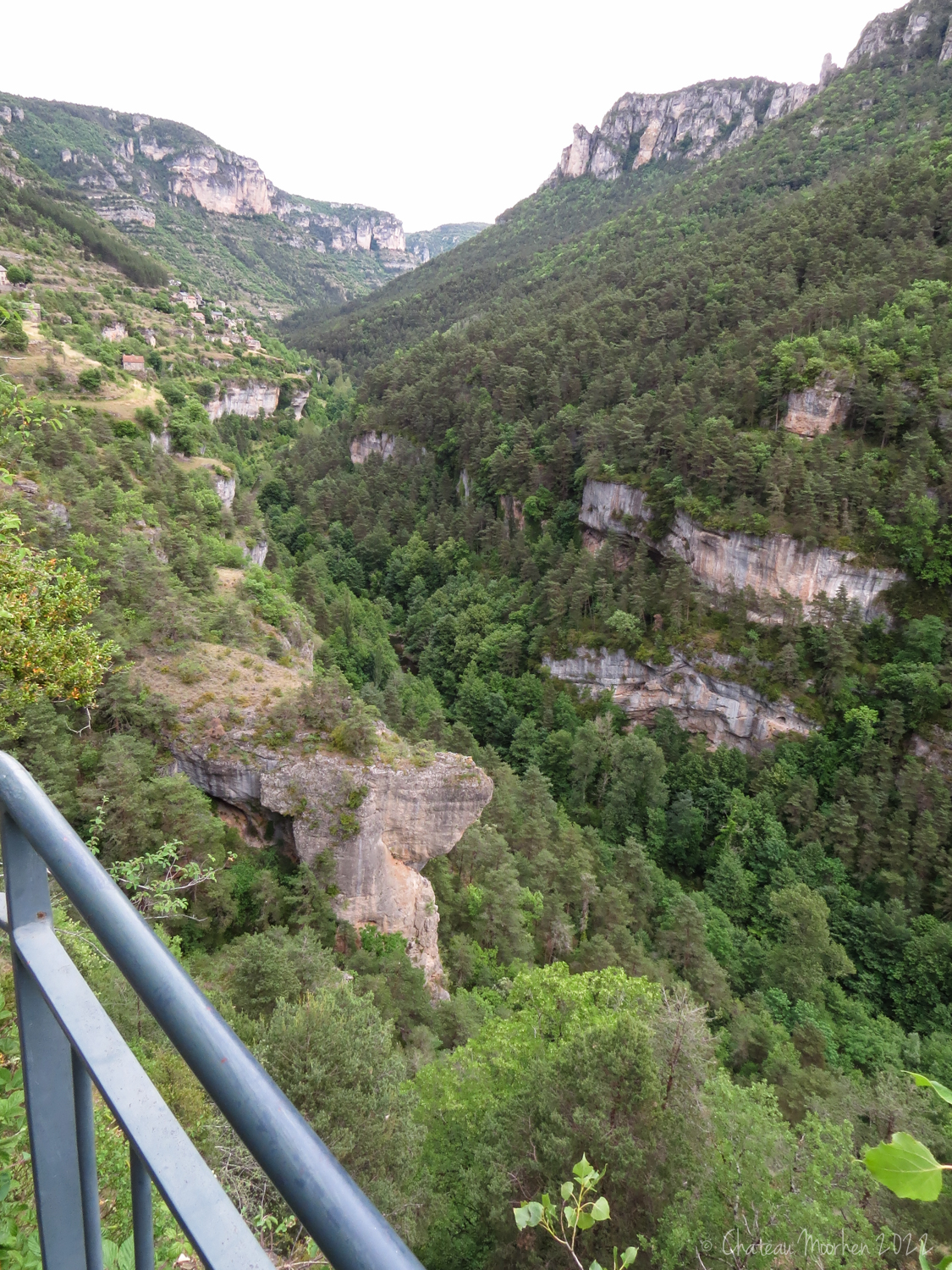
Info board (actually in decent English!) about the gorge behind me. This is the Gorge de la Dourbie river - it's one side of the Causse Noir where we were, and the vulture museum in the Gorge de la Jonte was the other side of the Causse Noir. The Causses are limestone plateaus, and there are five of them in this area. Some are a part of the Cevennes National Park. See the map below. Millau is at the tip of the Causse Noir, where the Tarn and Dourbie rivers meet.
Image credit: Paysage Aveyron
There were plenty of plants in flower and due to the altitude, were behind the flowering season of plants down nearer sea level. As well as many garrigue plants, I came across two orchids. I don't have a close up of this one, but it came back on PlantNet as 11% likely to be Fragrant Orchid (Gymnadenia conopsea). Now I wish I’d sniffed it!
This next one was easier to ID, it is Red Helleborine (Cephalanthera rubra).
Some of the faces in rocks: I think this next is the one they called 'Cyrano's Nose' (i.e. Cyrano de Bergerac, who had a long nose). I think it also looks like a Toby Jug, though I'm not sure about the chimney coming out of the back of the head. π
I don't know what this next one was called, if at all, but I see two faces, sideways on, with their chins jutting out. The one closest is wearing a mask (the trees). Or they could be skulls, the tree part being the eye socket. Depends which way I look at them. What do you see? π
Before heading back down to Millau we stopped at the far tip of the Causse Noir, a hill known as Puncho d'Agast, which is used for launching paragliders, and has a radio mast. We could see it from our campsite, as in the photo below.
This is the view from up the top. I'll save you the vertigo inducing photo of the man climbing up inside the radio mast this time though.
Looking over towards the Causse de Larzac to the south.
Again there were garrigue type plants here, despite the Causse Noir being mainly forested (hence I suppose it's name?). Many of the causses are very open and used for sheep farming, not that we saw much in the way of sheep.
This tree's seed pods fascinated us and I've found out that it is called Bladder Senna (Colutea arborescens) from the pea/bean family, Fabaceae.
As you can see from the photo of me up above, it wasn't very warm on this day, so I didn't see many butterflies until the following day, when the sun came out and the heat hit us - for the rest of our holiday. I can't complain too much when it means the butterflies come out to play, and I'm looking forward to getting to that bit on the blog!
Blog Header
Thursday, 7 July 2022
Saturday, 2 July 2022
Albi, le Rougier de Camares and the vulture museum at the Gorge de la Jonte
I've already shared a few photos from these places but I said I would add some of the interior of Albi cathedral, plus some of Keith's photos of vultures, so here goes.
The Sainte CΓ©cile cathedral at Albi (capital of the Tarn department) was built between the 13th and 15th centuries and the building on the right is a part of the Bishop's Palace, the Palais Episcopal de la Berbi, built before the cathedral itself in a defensive style as the Catholics were at war against the Cathars at this time. It now houses the Toulouse-Lautrec museum.
Whilst I don't have a religious bone in my body, I do appreciate very ornate church and cathedral interiors. Just trying to imagine the work that is involved in the decoration of these places is almost beyond belief! Whether it's the painting, particularly on the ceiling, or the sculptured stonework, they are all equally amazing and the talent involved in those ancient times is sadly mostly lacking in these modern times.
Looking back in the opposite direction.
The amazing ornate ceiling:
Beautiful red stone (marble?) font:
The old bridge, construction of which started in 1040! At one point in the middle ages, it had houses on it, but these were partially destroyed during a flood.
There were dozens of pigeons nesting in amongst the stones!
The new bridge, built in 1868.
The cathedral and Palais de la Berbie from the old bridge:
This building is right beside the old bridge, and I found it fascinating because the base under the patio is so dodgy looking! Not sure I'd want to sit out there. π
The collegiate Church of Saint Salvi, built in the 11th century.
On to the Rougier de Camares, weird outcrops of red clay full of iron oxide interspersed with occasional horizontal grey clay strata. It is a very strange valley full of these red patches of earth. Due to the clay, the soil is supposed to be quite moist, which explains the sphagnum moss in many places, but not the wild thyme growing through it!! One likes damp soil, the other dry.
I loved this grass, and found out later that it is Stipa pennata - which like Stipa tenuissima is also called Angel's Hair Grass. Stipa pennata grows across the Causse de Larzac near Millau, in which direction we were heading.
Another attractive wild grass:
We then spent three nights at Millau, a town near the fairly new viaduct de Millau, a motorway bridge across the Tarn river valley near Millau, designed by British architect Norman Foster. There were so many places of interest to visit around here, that we didn't even find time to visit the town itself! We will be back another day.
There are four species of vulture that nest around here, but by far the most common are the Griffon Vulture. There is one couple of Black Vultures, a handful of Egyptian Vultures and the Bearded Vulture or Lammergeier which is the rarest. This last we have yet to see.
These next images are all taken by Keith with his 800mm lens - as you can see from the image above, the cliff faces were a long way away, and these Griffon Vultures in the photo below are on the same cliffs. My few photos with my SX50 were terrible!
Photo credit: Keith Allen
On this next photo, you'll need to view it full size as the vulture is the tiny looking bird right in the centre of the image! It's actually a Black (or Monk) Vulture (Aegypius monachus), much rarer than the Griffon Vultures and in fact there is only one pair nesting in this area this year; how lucky they chose to build their nest in full view of the viewing platform! They are the only vultures that build nests in trees. It's not in the photo but we could see the youngster's little head bobbing up and down - apparently it was about six weeks old.
Photo credit: Keith Allen
Back to the Griffon Vultures (Gyps fulvus):
Photo credit: Keith Allen
Back soon I hope with more holiday photos!
The Sainte CΓ©cile cathedral at Albi (capital of the Tarn department) was built between the 13th and 15th centuries and the building on the right is a part of the Bishop's Palace, the Palais Episcopal de la Berbi, built before the cathedral itself in a defensive style as the Catholics were at war against the Cathars at this time. It now houses the Toulouse-Lautrec museum.
Whilst I don't have a religious bone in my body, I do appreciate very ornate church and cathedral interiors. Just trying to imagine the work that is involved in the decoration of these places is almost beyond belief! Whether it's the painting, particularly on the ceiling, or the sculptured stonework, they are all equally amazing and the talent involved in those ancient times is sadly mostly lacking in these modern times.
Looking back in the opposite direction.
The amazing ornate ceiling:
Beautiful red stone (marble?) font:
The old bridge, construction of which started in 1040! At one point in the middle ages, it had houses on it, but these were partially destroyed during a flood.
There were dozens of pigeons nesting in amongst the stones!
The new bridge, built in 1868.
The cathedral and Palais de la Berbie from the old bridge:
This building is right beside the old bridge, and I found it fascinating because the base under the patio is so dodgy looking! Not sure I'd want to sit out there. π
The collegiate Church of Saint Salvi, built in the 11th century.
On to the Rougier de Camares, weird outcrops of red clay full of iron oxide interspersed with occasional horizontal grey clay strata. It is a very strange valley full of these red patches of earth. Due to the clay, the soil is supposed to be quite moist, which explains the sphagnum moss in many places, but not the wild thyme growing through it!! One likes damp soil, the other dry.
I loved this grass, and found out later that it is Stipa pennata - which like Stipa tenuissima is also called Angel's Hair Grass. Stipa pennata grows across the Causse de Larzac near Millau, in which direction we were heading.
Another attractive wild grass:
We then spent three nights at Millau, a town near the fairly new viaduct de Millau, a motorway bridge across the Tarn river valley near Millau, designed by British architect Norman Foster. There were so many places of interest to visit around here, that we didn't even find time to visit the town itself! We will be back another day.
The first day here we visited the Vulture Museum beside the Gorge de la Jonte, a scenic drive and gorge in itself, even without the vulture interest. I've shown a few photos already but have some vulture photos now to share.
There are four species of vulture that nest around here, but by far the most common are the Griffon Vulture. There is one couple of Black Vultures, a handful of Egyptian Vultures and the Bearded Vulture or Lammergeier which is the rarest. This last we have yet to see.
These next images are all taken by Keith with his 800mm lens - as you can see from the image above, the cliff faces were a long way away, and these Griffon Vultures in the photo below are on the same cliffs. My few photos with my SX50 were terrible!
Photo credit: Keith Allen
On this next photo, you'll need to view it full size as the vulture is the tiny looking bird right in the centre of the image! It's actually a Black (or Monk) Vulture (Aegypius monachus), much rarer than the Griffon Vultures and in fact there is only one pair nesting in this area this year; how lucky they chose to build their nest in full view of the viewing platform! They are the only vultures that build nests in trees. It's not in the photo but we could see the youngster's little head bobbing up and down - apparently it was about six weeks old.
Photo credit: Keith Allen
Back to the Griffon Vultures (Gyps fulvus):
Photo credit: Keith Allen
Back soon I hope with more holiday photos!
Tuesday, 21 June 2022
Cordes sur Ciel, Tarn
We have been home for a few days now, full of unpacking a motorhome and doing tons of laundry, not just ours but the bedding and towels from our friends who came to housesit for us. It always takes an age to get through it all, and there are three of us this time!
I've managed to whittle down about 90 photos of Cordes to just a few, but we weren't anywhere where we could get a photo like this, as I think we came into the village via the 'wrong' way. So I've borrowed this image from the Tarn Tourist Guide.
I'm so pleased I chose to visit this delightful village, as previously we had seen it from a distance, rising out of the countryside up towards the sky; it really stuck in my mind and I had always wanted to come here.
As you can imagine, there is a lot of walking involved, although there is a little tourist train that you can take, if you happen to be in the right place at the right time. We walked!
I loved this house! Butterflies and insect hotels galore, and even a stone cat.
Cordes sur Ciel was built back in the 13th century as a bastide (new) town, originally conceived to resettle and shelter people who had been displaced by the Albigensian Crusade. Reading about this subject, I had always though bastide towns were defensive towns, but apparently not, though many were built in defensive positions such as on top of hills.
The covered market on the right was built in the 13th century as well, now it has many restaurant tables there making the most of the shade on the hot summer days.
Saint-Michel Church, also mostly dating from the 13thC.
There are a number of well preserved gothic mansions, such as the Maison de Grand Veneur below.
And lovely little artisanal shops dotted about here and there.
One of the gates to the oldest part of the town on top of the hill.
This poor house, it had been patched up with all sorts of building materials over the decades/centuries. It could be beautiful.....
There were a number of houses like this with bricks between the timbers, some very attractively done.
Another gate into the older part of town.
On our way down we visited the Jardin de Paradis, a lovely terraced garden with many places to sit and relax. The water garden had a number of frogs sitting on the lily pads and there was even a level dedicated to veggie growing.
All that on just day one of our holiday! I loved our all-too-short holiday, apart from the heat at times! Many of the places we travelled through I would like to go back to to see more. Maybe next year.... π
Subscribe to:
Posts (Atom)